Programme content and structure
Seven semesters to become a medical assistant
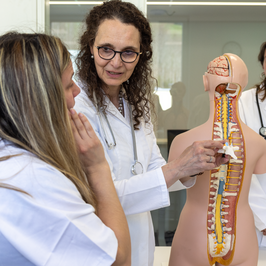
On the Physician Assistant programme you'll gain initial insights into the profession in subjects such as anamnesis, anatomy, physiology and rehabilitation. After that, you'll focus more and more on clinical subjects and diagnostics. You'll also be taught fundamentals of the natural sciences and get an introduction to scientific methods.
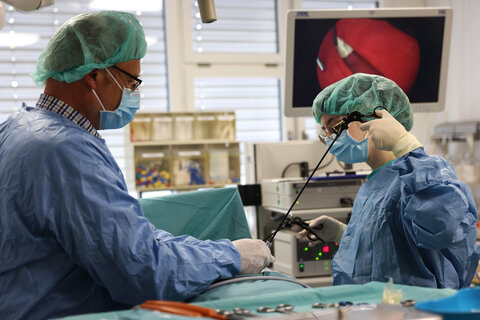
We show you how an EEG or ECG works - so that you can apply this in the third semester when you go into practice. We work together with various practice partners in the region, for example with many clinics where you can work in a wide range of specialist areas.
Of course, you will also learn about professional law and the structures of healthcare and billing systems. In the second practical semester, you can specialise further before writing your thesis in the seventh semester and graduating!
Entry requirements
Supporting documentation
Only a university entrance qualification is required.
Additional proof is required for subsequent enrollment:
- Proof of a four-week nursing internship
- Police clearance certificate (document type NE)
- Proof of the required vaccinations for the healthcare sector
- Medical certificate of medical fitness to work as a Physician Assistant
PA specifics
What's covered
Theoretical and practical content of your PA degree programme
Medical basics for patient-related activities, especially in the fields of surgery, internal medicine, central interdisciplinary emergency room, anesthesia and intensive care medicine:
- Basic natural sciences, anatomy/physiology, pathology/pathophysiology, pharmacology, microbiology/hygiene
- Clinical medicine (basics, principles, procedures), anamnesis, physical and instrumental examination, surgical teaching, functional diagnostics
Main subjects:
- Internal medicine: nephrology, cardiology, pulmonology, infectiology
- Surgery: cardiothoracic surgery, urology, ENT, ophthalmology, dermatology
- Emergency medicine/emergency management, anesthesiology
Selection of other specialties:
- Orthopaedics/trauma surgery
- geriatrics
- Pediatrics
- Psychiatry and psychosomatics
- Gynecology/obstetrics
- Neurology
General process management with the basics of law, economics, IT, quality management, medical technology in the form of lectures and seminars in the subjects:
- Public Health
- Legal aspects
- Medical technology/medical devices
- Information technology, quality management
Medical process and documentation management, such as content on patient care, compliance management, treatment planning and treatment documentation:
- Documentation, remuneration and healthcare system
- Key skills: project management, moderation techniques, presentation, conflict management, communication and discussion techniques
- Fundamentals of scientific theory and scientific methods
Special features
This study programme is not a medical degree, and no license to practice medicine is issued after graduation. As a PA, you are bound by instructions when providing medical treatment, which means that the responsibility is borne by the doctor who has assigned the treatment to you.
You do not need any prior training to apply for the Physician Assistant course. However, you must have completed a four-week internship in nursing by the end of the first semester at the latest so that you can be sure that working with patients is right for you.
Your career prospects
We only have to mention the shortage of specialists ...
As a PA, you can work in inpatient care in urban and rural areas, for example in a general medical practice or hospital.
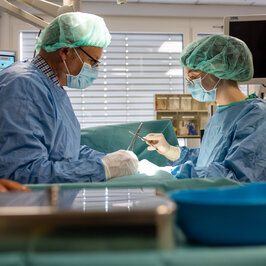
As an assistant to the medical management in medical departments, the fields of activity range from treatment documentation to supporting interventions in emergency care. Whether in surgery or taking over patient consultations - you are always close to people in all medical specialties, with this degree you have career prospects at home and abroad! PAs are highly valued employees in the practice, allowing medical specialists to focus more on their area of specialisation.
FAQ
When does the Physician Assistant programme begin?
Students can begin the Physician Assistant programme at HFU each year in the winter semester.
Is there a minimum grade requirement for the programme?
Generally, no. However, if there are more applications than available places, applicants will be sorted based on their university entrance qualification grades and admitted accordingly.
Do I have to do a pre-study internship?
The university requires a four-week nursing internship. Proof of completion of the nursing internship must be submitted to the Admissions Office by the end of the first semester at the latest. Individuals with prior medical training (e.g., vocational training, FSJ in the nursing field) can have this recognised as an internship. Please contact the HFU Admissions Office in plenty of time.
Do I have to sign a training contract with a hospital before starting my studies?
No. In the second or fifth semester, students apply either to partner clinics or to other medical institutions. However, if no practical placement is confirmed, students will be assigned to any remaining placements at partner hospitals.
How are the theoretical and practical courses planned?
The theoretical and practical courses will take place at Furtwangen University on the Schwenningen campus. Here, students will acquire both academic knowledge and practical skills. In addition, the standard period of study of seven semesters includes a total of two practical semesters in medical facilities. During these semesters, students have the opportunity to apply their scientific, theoretical, practical, and strategic skills and abilities to patients.
How much attendance time will there be, and will some of the courses take place online?
University teaching will take place four to five days a week (approx. 4.5 to 8 hours per day on average). Courses will be held in person, online, or as blended learning courses. The current SPO lists which courses will be held online. During the practical study semesters, you should expect to work full-time (38 to 40 hours per week).
Where do the practical study semesters take place?
The practical study placements take place in medical facilities, e.g., at HFU cooperation partners. These are usually located in Baden-Württemberg.
Do I have to find a place for the practical study semesters myself?
Yes. In the second or fifth semester, you must apply independently for a practical semester at either partner clinics or other medical institutions. However, if you do not receive confirmation of a practical placement, you will be assigned to one of the remaining placements at partner clinics.
What will I be after graduation?
After completing your studies, you will receive a Bachelor of Science degree and can work as a physician assistant.
What are the career prospects?
As a physician assistant, you will assist the medical management.
Possible areas of activity:
- Inpatient care in urban and rural areas, for example in a hospital or general practice
- Assisting the medical management in medical departments: The fields of activity in the inpatient sector are extensive and range from treatment documentation to assisting with emergency care procedures
- Opens up career prospects at home and abroad
- University career path from master's degree to doctorate
Can I also study to become a physician assistant on a part-time basis?
Yes. In this case, the PA team will work with you to put together a suitable, individualised study plan. The two practical semesters can also be completed on a part-time basis. However, the final thesis must be completed on a full-time basis. Please note that if you choose a part-time solution, your studies will take longer.
Can I switch between part-time and full-time study in the Physician Assistant programme?
Yes, you can switch from full-time to part-time or from part-time to full-time studies once during your degree programme. This means that if you start as a full-time student, you can switch to part-time studies, but you must then complete your degree on a part-time basis. A second change is not possible. If you would like to start your studies part-time, you must apply to the Student Affairs Department before enrolling. If you would like to switch to full-time during your studies, you can do so, but you must then complete your studies full-time. A second switch to part-time is not possible.
Your key contacts
Your future is important for us. Contact us for advice.