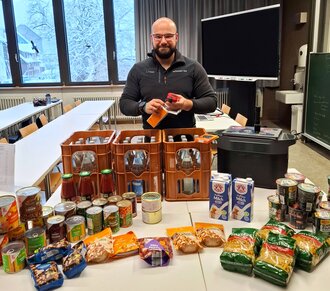
Linus Frederik Fabian and his personal supplies for 10 days
Furtwangen University bachelor's thesis on crisis management in companies
Three crates of water, a mountain of instant noodles, canned ravioli, nuts, and much more are spread out on a table in lecture hall C 0.09 at Furtwangen University (HFU). What looks like shopping for a camping trip is actually preparation for a lesson on supplies in the safety department. Linus Frederik Fabian has been working on crisis management in companies for his bachelor's thesis in the “Security & Safety Engineering” (SSB) programme. Today, he is presenting his findings, which can be easily applied to private individuals, to the first-semester SSB students. “In Germany, we are safe, but not immune. The most likely threat is a power outage, which in many regions also means a failure of the water supply,” reports Fabian.
In preparation for an emergency, the Federal Office for Civil Protection and Disaster Assistance (BBK) recently updated its guidelines. “The BBK recommends stocking up on 10 days’ worth of supplies. An adult needs 2,000 to 3,000 kilocalories per day and two litres of drinking water – that adds up to quite a lot,” explains Fabian as he places the last packet of pasta on the pile. He recommends foods with a high energy density, such as nuts, oatmeal, and canned bread. However, it is important to only buy food that you actually like to eat. “Having your own supplies can relieve the burden on emergency services in an emergency,” says Fabian. That's why the 28-year-old now stores three large plastic boxes in his basement. “In the event of a disaster, you can go to the so-called ‘lighthouses’, the collection points set up by the Federal Agency for Technical Relief, the fire department, and rescue services, where you will also be provided with supplies. But it's better if you can stay at home for the time being,” explains Fabian.
He wrote his bachelor's thesis in cooperation with the company TransnetBW, for which he now also works while studying for his master's degree in Risk, Reliability and Safety Engineering at HFU. The issue of supplies will also become increasingly important for companies in the coming years. For example, the load on the grid is continuing to increase due to the use of AI, which could lead to more frequent power outages. There are currently no legal requirements for crisis preparedness in companies. Fabian explains, “Some companies, such as electricity suppliers, stockpile supplies for their most essential employees, who can then help solve problems in the company in an emergency. However, many other companies are not yet as well prepared.”
Things get exciting in the lecture hall when everyone gathers around the mountain of food to inspect its contents more closely. Most of the students are surprised by the amount of food needed for just ten days. Everyone agrees that it is important to address the issue early on, and the first students are already thinking about where in their shared apartment they will store their supplies. Fabian sums it up like this, “By the way, preparation has nothing to do with prepping or scaremongering. Those who are prepared relieve the burden on helpers and ‘beacons’ and assume social responsibility in society.”