As individual as people are
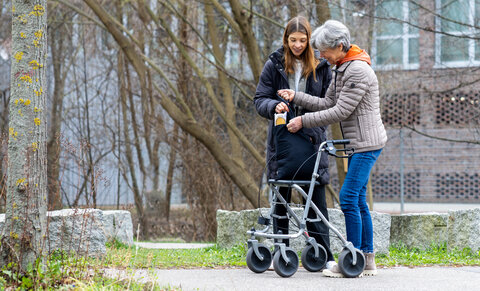
In our planned professionally qualifying Occupational Therapy study programme, you will learn how to encourage, advise, and support people in leading as independent a life as possible. After successfully completing your studies, you will be able to help them fundamentally improve their health, quality of life, and well-being. Working in occupational therapy is as individual as the people you will be working with.
In our Occupational Therapy programme, you will study in an integrated training programme. This means that you will earn two degrees − the state-recognised occupational therapy qualification and a bachelor's degree.
The planned location of study is primarily the Freiburg Study Center. The earliest start date is subject to change but is currently scheduled for the winter semester 26/27.
Programme content and structure
Study occupational therapy in a modern way
The curriculum was developed in partnership with experts in occupational therapy training. These experts bring with them many years of experience in training occupational therapists and in client care. Our focus is on the ideal integration of theory and practice with a special emphasis on evidence-based practice, intervention simulations in skills labs, and contemporary practical training in occupational therapy workplaces. Cooperation with a vocational school is planned.
Structure of the programme
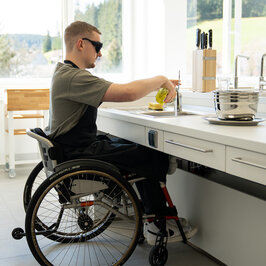
At the beginning of your programme, we focus on human activity in everyday life and how medical, social science, and scientific principles relate to these. You will also learn the basics, models, and paradigms of occupational therapy and how to classify them in the health, social, and education systems. You will then deepen your knowledge of prevention and health promotion. You will deal with various everyday living environments in which occupational therapy work takes place. Based on the individual's everyday life, the evaluation of individual concerns and roles, as well as the challenges faced by clients, the objectives of the therapy and thus the appropriate interventions are developed to fit each individual case. Occupational therapy concepts are explained using case studies and applied in a person-centered manner both in individual settings and in groups. You can try this out in our multi-professional Skills Lab which includes a teaching kitchen and model apartment.
Internal link opens in the same window:Take a look at our Skills Lab on the Furtwangen Campus.
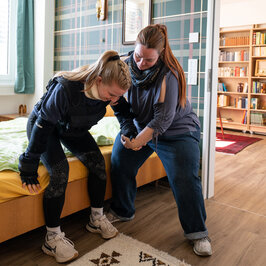
The practical training phases begin in the third semester at various cooperating institutions. There you will gain practical experience in different settings and can try out your acquired knowledge in practice. The practical placements take place in psychosocial, motor-functional, neurophysiological, and/or neuropsychological areas as well as in occupational therapy areas and prepare you in the best possible way for occupational therapy work after graduation.
Examination and qualifications
At the end of the sixth semester, you will take the state examination to become an occupational therapist. This will grant you the professional license that allows you to work in Germany. You complete your studies after the seventh semester with the submission of an academic thesis, the bachelor's thesis. This means you have two qualifications under your belt which allows you to work therapeutically and paves the way for an academic career or future management positions. The choice is yours!
ET specifics
Occupational therapists support people of all ages in participating in the everyday activities that are important to them in their living environment. The theory and practice of occupational therapy focuses on concepts such as human activity, scientific evidence and subjectivity of the context, supplemented by resource orientation and person-centeredness. The central goals of occupational therapy are to improve participation, quality of life and a self-determined lifestyle. The promotion of health and well-being through meaningful activity is of paramount importance. Everyday activities of all kinds are used as both a goal and a method to improve or, if necessary, regain the skills required to lead as self-determined a life as possible. Occupational therapists work in the health and social care sector, where they make an important contribution to care in both inpatient and outpatient contexts. They form an important interface between medical care and social participation by contributing to acute and chronic healthcare, rehabilitation, health promotion and disease prevention. They are also active in training and research institutions.
What's covered
Semester fees
Special features
Thanks to our planned partnership with a vocational school for occupational therapy, it is possible to study with us as part of your training. You do not need to apply separately to the vocational school or an employer. Simply send your application to us.
Please note that this is a demanding full-time programme of study, as you will be working toward two qualifications. Both the theoretical and practical phases of the programme require a high level of commitment to learning.
The cooperating vocational school is located in the Freiburg Study Center. There, you will benefit from modern facilities and interprofessional exchange with other trainees and students from the healthcare professions. External link opens in a new window:Click here to get an impression of our facilities in Freiburg.
This new degree programme allows you to obtain two professional qualifications within 3.5 years (as opposed to three years of training). You will obtain your professional license after three years and your bachelor's degree six months later. There are no high training costs, only semester fees. The 1,700 hours of practical training correspond to traditional training. You will therefore acquire all the practical skills with us, as they are also anchored in vocational school training. The difference is that you can apply these skills with considerably more specialist knowledge from the field of science and research.
Your career prospects
Internationally, a bachelor's degree in occupational therapy is standard. University-trained occupational therapists are urgently needed on the job market. There is a shortage of qualified staff in a wide range of specialist facilities. With your degree, you can therefore choose where you would like to work, e.g. in inpatient care or in outpatient healthcare settings. There are also many areas beyond clinical or outpatient occupational therapy in which occupational therapists are needed, such as in occupational health promotion, in school settings, as job coaches, in spatial planning, architecture, environmental protection and refugee aid.



Events
Unfortunately, there are currently no events planned that we can display here. We have compiled an overview of all planned events in the event calendar.
Your key contacts
We're happy to help you with any questions you have about our new programme.