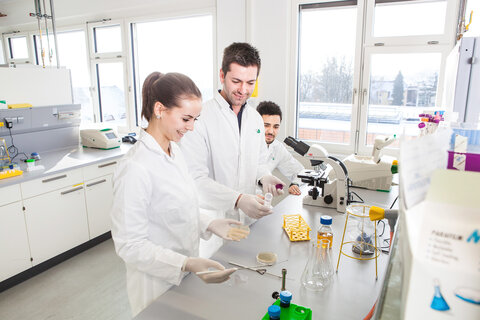
Shape the future of medicine
Do you want to understand how the human body works—from the largest structures down to the smallest molecules? What processes lead to the development of diseases? And how can these be identified, analysed, and treated?
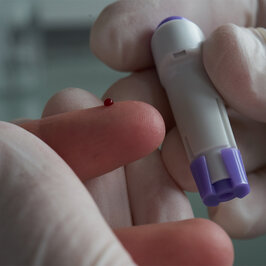
Here, you will not only learn how health and disease interact at the molecular and cellular level, but also how modern diagnostics work.
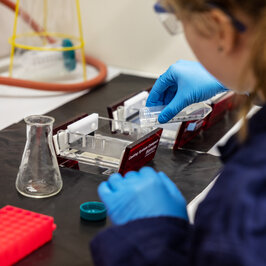
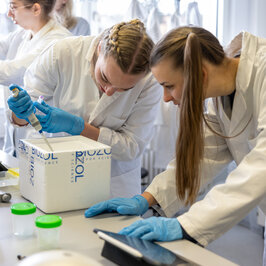
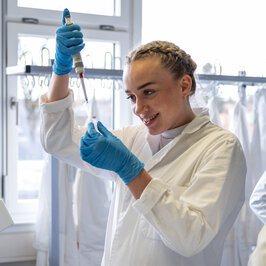
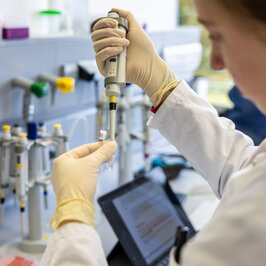
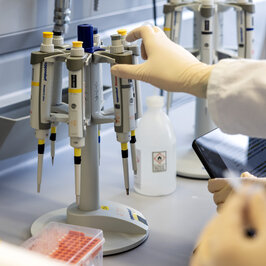
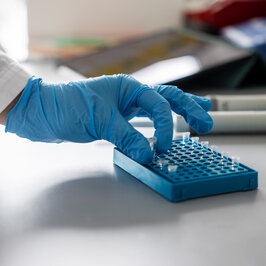
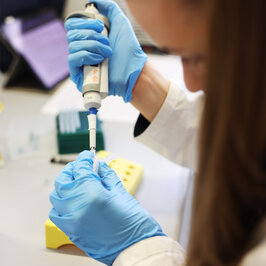
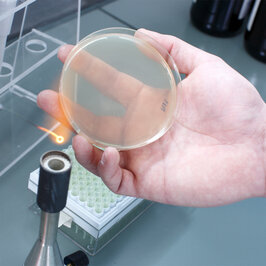
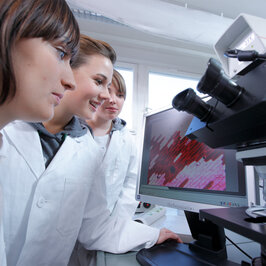
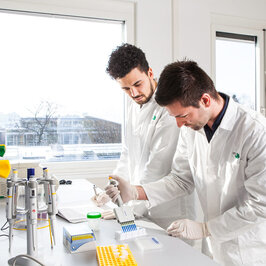
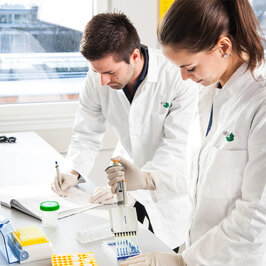
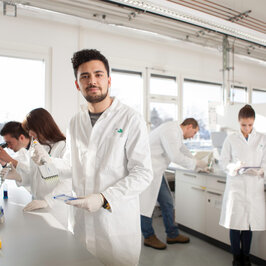
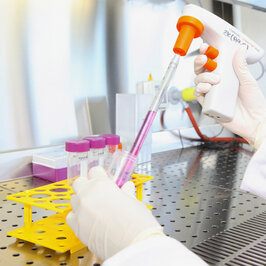
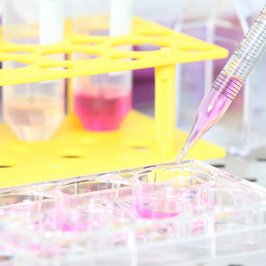
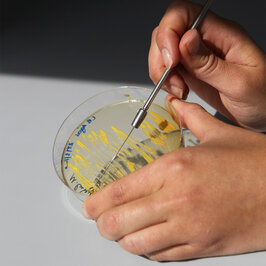
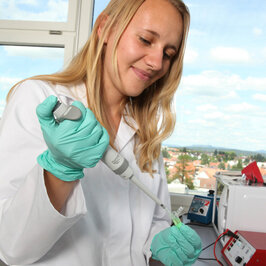
There is a special focus on practical training − in laboratory internships, you will learn techniques from molecular biology, cell biology, and microbiology. In addition to biological and medical content, an exciting technical component awaits you − imaging, bioinformatics, and data analysis will prepare you for the future.
Thanks to the bilingual orientation, you will be well prepared for a career in science and industry.
Programme content and structure
Modern biomedicine makes an important contribution to overcoming the major challenges of the 21st century. That's why you'll be studying current topics on our degree programme - across disciplines. In addition to traditional natural sciences and molecular biology, you'll also be taught application-related content from medicine, laboratory diagnostics and medical technology. The analysis of large amounts of data is becoming increasingly relevant, and we also train you in this area. This will give you a head start in many different professional fields. Because Internal link opens in the same window:new topics and techniques are constantly taking centre stage both in the job market and in research, we are constantly optimising our course content to keep you up to date!
Do you have questions about MTZ? Download file:You can find our FAQ here.
Entry requirements
MTZ specifics
What makes us stand out from the crowd
- High practical relevance thanks to numerous laboratory internships in small groups, the practical semester, and the bachelor's thesis (both preferably at a research institution or in a company).
- Interdisciplinarity: You will not only learn about human biology/medicine, but also scientific work, quality management, and business administration. This content will help you in your career in science, industry, and applied research. In addition, the wide range of content provides you with a foundation for many advanced degree programs.
- Flexible study: If you wish, you can spend three of the seven semesters elsewhere. We will provide you with the best possible support in finding a place for your practical semester, a semester abroad, or your thesis in a company or research institution.
- High research focus: We are one of the strongest universities in terms of research and the strongest faculty at HFU. You will benefit from well-equipped laboratories and the opportunity to participate in projects.
- Bilingual degree programme with optional bilingual degree. You can find more information below in the Special features section.
If you would like to study with us, your chances are very good. Internal link opens in the same window:Apply now - we look forward to seeing you!
What's covered
Semester fees
Special features
We're international and bilingual
English-language subjects are a compulsory part of the curriculum. These are mainly found in the main study period. To make it easier for you to get started, compulsory language courses are held in the first two semesters, in which you will be placed (after a language test). By the end of your studies, you will have achieved at least English level B 2.2.
Bilingual degree
The bilingual degree is optional. To achieve this, you must complete at least 61 ECTS credits in English out of the 210 ECTS credits required for the bachelor's programme. In addition, you must provide proof of at least level C1 English through an independent language test.
- During your studies, you have the opportunity to earn ECTS credits in English, e.g. through:
- English-language courses at HFU (including electives)
- Internal link opens in the same window:Internship semester abroad: The main language of communication at the internship must be English.
- Internal link opens in the same window:Semester abroad with English as the language of instruction.
- Thesis: The thesis must be written and presented in English. English is recommended as the main language of communication in the working group/institution.
- Students who have completed at least 61 ECTS credits in English during their main studies can apply for the bilingual degree at the end of their studies by contacting the Dean of Studies.
Semester abroad testimonials
Your career prospects
The second Internal link opens in the same window:MTZ Alumni Afternoon on 23.05.2025 provided valuable insights into different career paths and highlighted the diverse professional prospects available after graduation.
Employment sectors
Business and industry, research and development
- Basic research, applied research
- Quality management / quality assurance
- Product development / product management
- Laboratory facilities, research and development
Basic research, doctorate
- Development and implementation of scientific and general evaluations
Clinics and medical care centers
- Collaboration in diagnostics
- Quality management, hygiene
- Medical technology, laboratory technology, environmental protection, environmental medicine
- Cardiotechnology (after appropriate specialisation)
- Collaboration in the design and implementation of clinical studies
Authorities with a focus on safety, environment and hygiene
- Quality management
- Hygiene management
- Infection control
FAQ
What prior knowledge is required for the Molecular and Technical Medicine programme?
No specific prior knowledge is required, but you should have an interest in the natural sciences (biology, chemistry, physics, and mathematics) and in medical subjects (e.g., anatomy and physiology).
How much of the programme is devoted to mathematics, natural sciences and technical subjects?
In the first two semesters (the foundation study period), the proportion of chemistry, mathematics, physics and technology is relatively high at around 50 percent. These fundamentals are essential for studying in the natural sciences and technology. In the advanced study period, the biological and medical basics are deepened in an application-oriented manner.
I had relatively little mathematics/physics/chemistry at school. How would you assess my chances in the relevant subjects?
It is not possible to make a blanket statement. Success in these subjects depends heavily on personal commitment and your (prior) knowledge. If necessary, tutorials and exercises are offered in the relevant subjects. There is also the option of private tutoring. If you start your studies with us in the winter semester, we often offer so-called “bridging courses” in mathematics and chemistry. These courses review school content. If you have not taken these subjects by the end of your school career, for example, or if you know that you still have deficits in these subjects, we recommend that you participate in the bridging courses. These are voluntary and free of charge. You will receive information about the bridging courses after you have received your letter of admission.
Is it possible to start studying in the summer and winter semesters?
Yes, you can start studying applied biology in both the summer and winter semesters.
Where can I find information about the application and admission process?
Internal link opens in the same window:Find out how to apply for MTZ here.
What is the minimum grade requirement?
There is no general minimum grade requirement. The average grade required for admission to the programme has ranged between 1.9 and 3.0, depending on the number and qualifications of applicants. If the number of applications exceeds the number of available places, 90% of the available places are allocated via the university's own selection process and 10% via waiting list, after deduction of the advance quotas. In recent semesters, there has been no NC, meaning that all applicants have been admitted.
Is there a student council?
Yes, you can contact the Student Council of Faculty III via Instagram (fachschaft.fakultaet3) or by email: Email application is started:fa3-fach(at)hs-furtwangen.de
Can I have credits from other degree programmes or professionally acquired knowledge recognised?
Yes, under certain conditions and after review by the dean of studies. You will receive more detailed information at the beginning of your studies.
Is it possible to transfer into the programme?
Yes, it is possible to transfer into the programme, provided that there are still places available in the desired semester. You can indicate your desired entry semester in your application. Your application will be reviewed on a case-by-case basis to determine whether it will be approved. You can find more details in the information sheet on the application for admission. If you are unsure, we recommend that you start in the first semester; if necessary, you can then have courses credited.
Is there a suitable master's programme?
Yes, on our Schwenningen campus, we offer two master's degree programmes, “Precision Medicine Diagnostic (MSc)” and “Technical Physician (MSc).” You can enroll in these programmes directly after completing your bachelor's degree or after gaining some professional experience in order to obtain a higher qualification. The master's degree programmes start annually in the winter semester. According to the 2025 alumni survey, most of our graduates go on to complete a master's degree, mainly in the fields of biomedicine or molecular medicine.


Your key contacts
We're happy to advise you on the MTZ study programme!
Applied Biology (BSc) (ANB)
Molecular and Technical Medicine (BSc) (MTZ)
Physician Assistant (BSc) (PA)
Precision Medicine Diagnostics (MSc) (PMD)