Personalised advances
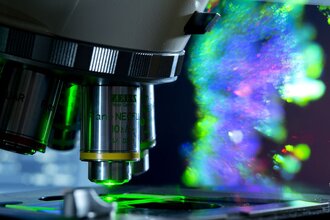
Research in the Molecular Biomedicine Laboratory makes an important contribution to innovations and technological advances in personalised medicine. Cell culture experiments and gene analyses contribute to the development of new diagnostic tools and treatment methods.
The Molecular Biomedicine Laboratory is available for teaching in the higher semesters. Thesis students, doctoral students and post-docs also work here on innovative projects. The laboratory meets safety level 1 for risk-free genetic engineering experiments and has an S2 area for working with microorganisms in risk group 2.
This is where the future is being created − innovative research and practical training in a dynamic and state-of-the-art environment.
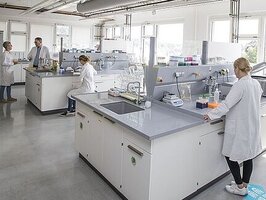

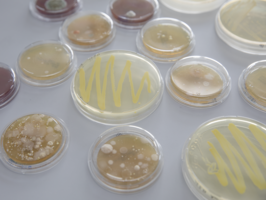
Purpose of lab
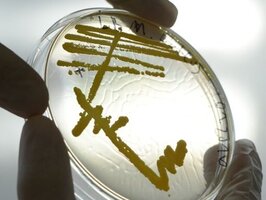
- Isolation and analysis of microorganisms from human and animal samples, for example by cultivation, MALDI biotyping and (next generation) sequencing
- Cell culture experiments and various gene expression analyses, e.g. using real-time PCR (qPCR)
- Genetic engineering work (S1) with cell cultures
- Work with microorganisms (risk group 2) under S2 conditions
- Fluorescence in situ hybridization (FISH)
- Sequencing of smaller genomes, amplicons and smallRNAs (next generation sequencing / third generation sequencing)
- 16S metagenomics & shotgun sequencing
- Quantification and detection of proteins
- Research on nanoparticles
Equipment
In addition to the standard laboratory equipment in the fields of cell culture, microbiology, molecular biology and, in some cases, biochemistry, the laboratory also has a number of devices that are used in diagnostics as well as in research.
MALDI biotyper
A method for identifying microorganisms that uses MALDI-TOF mass spectrometry to analyze the protein spectrum of a sample and compare it with a database of known spectra. This allows bacteria and fungi to be identified quickly and precisely down to species level.
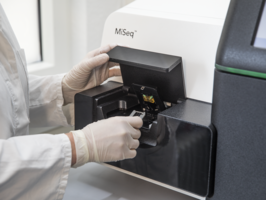
MiSeq
Illumina's MiSeq system is a next-generation sequencing (NGS) device that enables nucleic acid sequencing with high accuracy and relatively short run times. It is often used for applications such as microbiome analysis, amplicon sequencing and small genome projects.
GridION
Oxford Nanopore's GridION is an NGS sequencer that uses nanopore technology to analyse DNA and RNA sequences in real time and without prior amplification. It is suitable for a wide range of applications including long sequence reads and metagenomic analysis.
Flow cytometer
A laboratory device that passes particles (usually cells) in a liquid through laser beams to analyze their physical and chemical properties. It enables the simultaneous measurement of thousands of particles per second, making it ideal for applications in immunology, cell biology and diagnostics.
Light Cycler
This device uses quantitative or real-time PCR (qPCR) and is used for the amplification and quantitative measurement of nucleic acids in real time, e.g. for gene expression analyses and the diagnosis of infections (see SARS-CoV2 tests). Using fluorescence, the DNA concentration can be measured directly and precisely during the amplification process, enabling quantification.
Fluorescence microscope
Here, special fluorescent dyes are excited in order to visualize specific structures in biological samples. This enables the high-resolution visualisation of specific molecules and processes in cells and tissues, which is particularly useful in cell biology and microbiology.
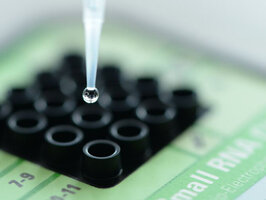
Microplate reader
This device measures the absorbance, fluorescence or luminescence in a microplate to analyze chemical, biological or physical properties of samples. It is often used in biotechnology, medicine and pharmacy, for example for enzyme tests, protein and nucleic acid analyses. E.g. ELISA (a method for detecting antibodies or antigens in a sample).
Ultracentrifuge
In contrast to normal laboratory centrifuges, this device achieves very high rotational speeds (up to 150,000 rpm) to efficiently separate particles such as macromolecules or cell components based on their density. Due to the strong centrifugal force, even tiny differences in the mass or density of particles can be analysed and separated.
Research and teaching as a single unit
Right from the start, students are introduced to scientific working methods in the laboratory through practical units and later have the opportunity to write their final theses there.
They can also contribute to the numerous publications of the working groups. The faculty is one of the strongest in research at the university and is excellently positioned internationally.
Further information
- Projects: Internal link opens in the same window:Institute of Precision Medicine
- Faculty: Medical and Life Sciences (MLS)
- Study programmes: Internal link opens in the same window:MTZ, Internal link opens in the same window:AGW, Internal link opens in the same window:PMD
Heads of Lab
We are happy to provide information about the Molecular Biomedicine Lab