Modern methods of substance analysis
Instrumental analysis is an important area of analytical chemistry that deals with the investigation and determination of chemical substances using technical equipment and precise measuring methods. A major advantage of instrumental analysis is its ability to deliver precise quantitative and qualitative results.
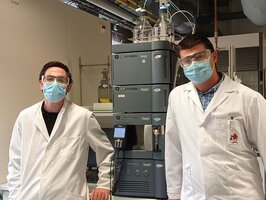
Instrumental analysis on the Schwenningen campus is spread across several chemical laboratories and includes chromatographic analytical methods such as gas chromatography coupled with mass spectrometry in addition to the usual spectroscopic methods.
Practically all the equipment is integrated into both teaching and research. From the analysis of spirits and mashes in the distillery and process solutions in the pilot plant and the synthesis products from the organic and bioorganic synthesis laboratory, to the microplastic samples from the water laboratory, a wide variety of samples can be analysed here both qualitatively and quantitatively.
The Internal link opens in the same window:Bioanalytics Laboratory on the Schwenningen campus is available to clarify complex mass spectroscopy issues.

Purpose of lab
- part of curriculum in the natural sciences/engineering degree programmes (Internal link opens in the same window:Applied Biology, Internal link opens in the same window:Molecular and Technical Medicine, Internal link opens in the same window:Medical Engineering - Clinical Technologies, Internal link opens in the same window:Precision Medicine Diagnostics)
- Free access for researchers after instruction
- On request, assistance with special analytical questions in the field of research and teaching
- Instrumental analysis is available to all project staff as required
Facilities & Equipment
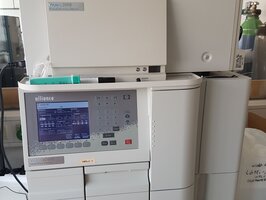
- Preparative HPLC (Waters Alliance)
Here, organic compounds can be purified to a high degree of purity, which is usually necessary if such compounds are to be analyzed microbially
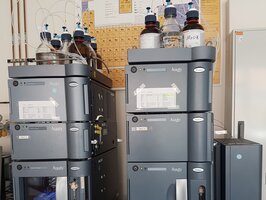
- Two Waters Acquity UPLC systems with DAD and UV detectors,
each equipped with different reversed phase columns, one for operation with water/methanol, the other for operation with buffers (bio-samples)
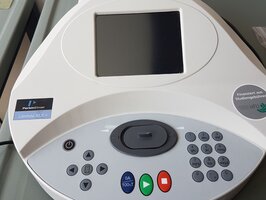
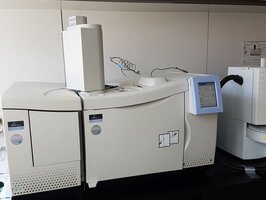
- Perkin lmer Clarus 600 GC-MS incl. headspace unit
for the analysis of volatile organic substances. The MS is equipped with a database for faster analysis, the headspace unit also allows the analysis of gas phases.
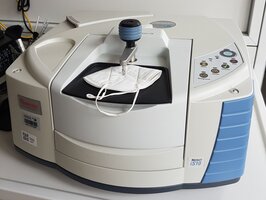
- FT-IR spectroscopy Thermo Fisher NICOLET iS10 with ATR unit
equipped with a database with 5000 substance data for fast analysis of organic and inorganic substances as well as materials
- FT-IR spectroscopy Bruker Tensor 27 with ATR unit
- FT-IR microscope Thermo Fisher
- UV/Vis spectroscopy various devices (Shimadzu, Perkin Elmer)
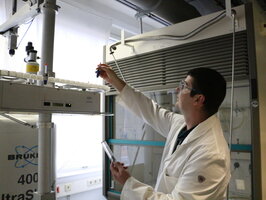
- 400 MHz Bruker Avance NMR spectroscopy
equipped with an inverted multi-sample head. Pulses determined for 1H, 13C, 31P and 29Si. Pulse determination potentially possible for all nuclei with nuclear spin except fluorine.
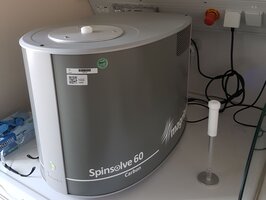
- 60 MHz Magritek benchtop NMR spectroscopy
Benchtop device of the latest generation for measuring 1H, 13C and 19F samples. Thanks to the external deuterium block, no deuterated solvents need to be used, making the device ideal for analysing reaction solutions.
- Biacore3000 (surface plasmon resonance spectroscopy, SPR spectroscopy)
used to measure biomolecular interactions. The method makes it possible, for example, to confirm binding between two proteins and to determine binding affinity and kinetics.
- Applied Photophysics SX20 (stopped-flow device)
can be used to measure fast reaction kinetics. Two solutions are mixed so quickly that reactions in the millisecond range can be observed and characterised.
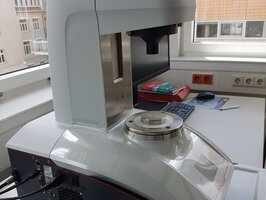
- Rheometer MCR 92 from Anton Paar
Rheology deals with the viscosity of substances. These can be liquids, but also soft or softenable solids. A rheometer is used to measure their behavior at different temperatures. It is an extremely sensitive and versatile analyser that can be used, for example, to determine the adhesive strength of an adhesive or the softening point or glass transition temperature of plastics and much more.
Team and useful links
- Scientific management: Internal link opens in the same window:Prof. Dr. Magnus Schmidt and Internal link opens in the same window:Prof. Dr. Nicolas Werbeck
- Technical management: Internal link opens in the same window:Dr. Josef Diebold
- Faculty MLS
- Internal link opens in the same window:Institute of Precision Medicine
- Study programmes: Internal link opens in the same window:Applied Biology, Internal link opens in the same window:Molecular and Technical Medicine, Internal link opens in the same window:Precision Medicine Diagnostics)
Head of Lab
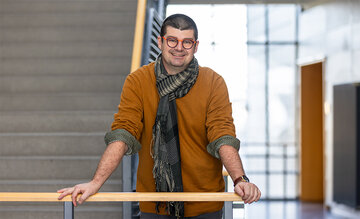
I'm happy to provide information about instrumental analytics.