Neuroscience and Consumer Behaviour
The Consumer Neuroscience Lab investigates the neurophysiological and psychophysical processes that shape economic behaviour and psychological decision-making. The research focuses on purchasing decisions, the perception of products and prices, and socio-psychological or cognitive processes, such as the assessment of attractiveness or social impact.
The Consumer Neuroscience Lab utilises various biometric methods to analyse people’s physiological responses and behaviour. These methods provide a deeper understanding of how people process information, make decisions and react to different stimuli.
Here, students have the opportunity to analyse the relationship between consumers and markets and to contribute to the development of products and services that meet people’s needs and expectations.


Purpose of lab
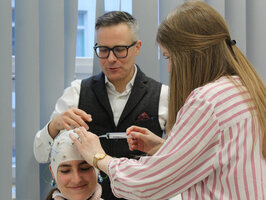
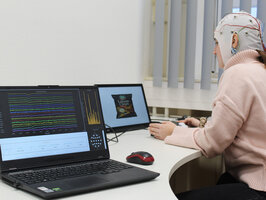
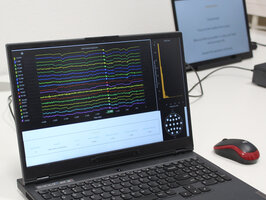
The laboratory utilises biometric and neuroscientific technologies to analyse the neurophysiological and psychophysical processes that shape economic behaviour and psychological decision-making. These include, amongst others, electroencephalography (EEG) for recording neural activity, eye tracking for analysing visual attention, and other experimental methods for measuring physiological responses and behavioural patterns. These methods make it possible to investigate decision-making processes where they occur – often beyond the scope of conscious self-reports.
A particular focus is on the investigation of multisensory influences. With the aid of an olfactometer, odours can also be controlled and precisely integrated into experimental designs. This allows perception and decision-making processes to be captured holistically and the interplay between different sensory modalities to be systematically investigated.
In addition to application-oriented research questions, the Consumer Neuroscience Lab also conducts fundamental academic research in the fields of cognitive psychology, consumer psychology and behavioural economics. The aim is to gain a better understanding of the fundamental mechanisms of information processing, evaluation and decision-making, and to provide empirical support for these theoretical findings.
Equipment
The Consumer Neuroscience Lab, headed by Internal link opens in the same window:Prof. Dr. Kai-Markus Müller, offers a wide range of instruments:
- A psychophysics laboratory with a research-grade button box
- A research-grade EEG device from PsyPhy
- Biometric measurement devices such as GSR and pulse rate
- A research-grade eye tracker from Tobii
- Research software designed for quick familiarisation
- An olfactometer from Burghart Messtechnik
Students have the opportunity to work with these technologies, develop their own research questions and play an active role in empirical projects. In doing so, they acquire both methodological skills and an in-depth understanding of the interplay between consumers, markets and decision-making in both academic and practical contexts.
Outstanding student projects
- Behavior Economics + KI
- Cheerleader Effect
- Download file:The Emotional Appeal of Hotel Rooms
- Fragrances modulate negotiation outcomes
- Game Theory and reverse e-auctions
- Odours and sustainable behaviour
- A Neurocognitive Investigation of Managerial Decision-Making: How AI Support Alters Cognitive Processing Mechanisms
- Judgement or Feedback? EEG Evidence for Differential Neural and Subjective Processing of Leadership Communication
Head of Lab
Interested in Consumer Sciences? Just get in touch with me!

Professor of Consumer Behaviour