Hydrogen meets VR
At the Tuttlingen 2025 Future Dialogue, the Internal link opens in the same window:“Automotive Transformation Strategy for south-west Baden-Württemberg” (AuToS SW-BW) project presented a special highlight − visitors were able to fully experience the functioning of a fuel cell using virtual reality. The Energy Storage Systems working group at IFC Tuttlingen demonstrated what innovative technology transfer looks like at Furtwangen University − practical, vivid, and in close cooperation with regional companies.
Focus on regional transformation: AuToS as a strong network player
On 30 October, 2025, the Tuttlingen campus of Furtwangen University was transformed into a "Internal link opens in the same window:Hightech City". Under this heading, the City of Tuttlingen, together with the Faculty of Engineering & Technology and the Friends of Tuttlingen Campus Association, invited guests to the Future Dialogue 2025. Numerous guests from regional companies, organisations, and associations took advantage of the event to learn about innovation potential, new research initiatives and partnership opportunities. Special emphasis was also placed on the projects of the Energy Storage Systems (ESS) working group led by Internal link opens in the same window:Prof. Dr. Frank Allmendinger.
The AuToS SW-BW project aims to support and catalyse technological and structural change in the automotive supply industry in the Schwarzwald-Baar-Heuberg region. In a region strongly influenced by the automotive industry, with around 25,000 employees, the question of future viability and competitiveness is of central importance. Through consistent knowledge and technology transfer, the development of new business models, and practical training opportunities, AuToS is helping to actively shape this transformation. An important basis for this is the university's research infrastructure in the field of hydrogen – in particular the modular fuel cell system test bench (MoSy) and the hydrogen training system (WaSS) – which were prominently on display at the event.
Virtual reality makes hydrogen reactions visible
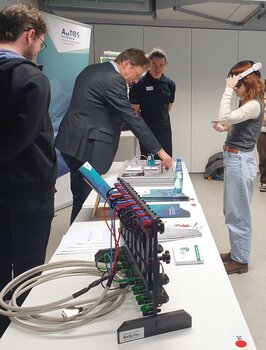
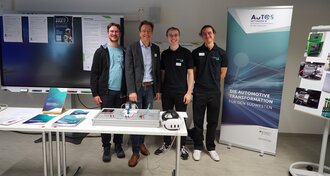
An immersive hydrogen experience that illustrated the invisible processes in a fuel cell attracted a great deal of interest. With the help of virtual reality, visitors were able to immerse themselves in how the technology works and intuitively understand the processes that take place in a fuel cell. The presentation was accompanied by Tobias Hauser from the Energy Storage Systems working group, while Victoria-Katharina Martinelli, academic assistant for science communication, supported the team. The VR application was developed by Paul Vogel, a student in the Internal link opens in the same window:engineering psychology programme. His interdisciplinary approach – combining engineering fundamentals with psychological usability research – contributed significantly to the impressive experience. As VR expert and Dean of Studies Internal link opens in the same window:Prof. Dr. Stefan Pfeffer emphasised, the application exemplifies how technological development and human-centered design can be combined to open up new perspectives on future technologies such as hydrogen.
In addition to the hydrogen activities, the BLITZ project also attracted a great deal of visitor attention. Project team member Stefan Raiber provided insights into current work on innovative pulse charging processes for lithium-ion batteries. The aim of the project is to accelerate fast charging processes while preserving the service life of the batteries. There was particular interest in the question of how batteries can be heated efficiently at low outside temperatures – an aspect that led to lively discussions in the job room.
Intensive exchange as a driver of innovation
The atmosphere in the job room impressively demonstrated the importance of personal exchange between research, industry, and students. The stands of the companies and university groups offered a wide range of topics for discussion, and many participants took the opportunity to find out more about research projects, career paths, and innovation potential. With its virtual fuel cell experience, hydrogen and charging projects, and commitment to automotive suppliers in the region, the AuToS project presented itself as an innovative and practical partner in the transformation – visible, connected and future-oriented.