Live smarter
The infrastructure in the Smart Home Lab enables the design, implementation and investigation of technical processes and various application scenarios in living spaces.
The aim is to improve the quality of life and safety of residents by networking household and entertainment devices and automating processes.
The infrastructure and behaviour of residents can also be analysed in order to better adapt the services offered to the needs of users. Continuous data stream analysis and machine learning techniques are used for this purpose.

Exemplary projects and research topics from the Smart Home Lab
- Morning routine: context-sensitive support for a pleasant “start” to the day
- Integration of humanoid robots into a smart home environment
- Control options using augmented reality and virtual reality
- “Magic Mirror”: camera-based selection of user profiles for person-specific configuration of smart home applications
“The shared flat in the lab”
A visit to the “smart home” at Furtwangen University
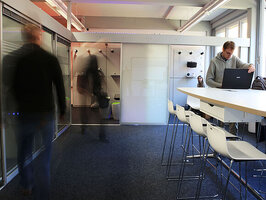
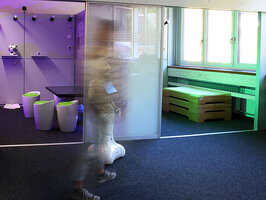
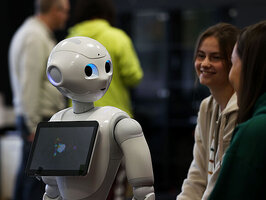
Among all the lecture halls, libraries and offices on the HFU campus in Furtwangen, there is also a very special kind of flat − this is where “Pepper” lives. Pepper is just under 1.20m tall and has around 30 square meters to live in − in addition to a bedroom, kitchen and bathroom, he also has a multimedia room and a “work zone” at his disposal. Pepper also has a younger brother − Nao sits on the floor and waits until he is allowed to play. The two are humanoid robots and receive lots of visitors in their shared flat, which is actually called the “Smart Home Lab”. Prof. Dr. Elmar Cochlovius is a permanent “guest” as Head of the Lab and introduces students from the Faculty of Computer Science and Applications to the world of the “Internet of Things” and digital mobility. “This means that real devices or systems are networked with each other,” he explains. “It gets exciting when these things communicate with each other!”
So what does the door handle say to the lamp? Probably “Go on!”, because someone has come in. In the smart home lab, students can try out what is possible. Many computers are connected to the large, shared work table. They not only control all the processes in the flat, such as heating, lighting and shutters (which can also be operated by voice or using Hololens glasses), but also Pepper and Nao when they show new visitors around the apartment or ask them to do a little exercise. In one simulation, students turn on a reddish light in the bedroom at wake-up time, birdsong is heard and the website of a news channel is projected onto the sliding glass door − is this the wake-up call of the future?
The playful approaches lead to research projects that investigate how everyday life could be made easier with technical assistance. For example, Pepper could regularly ask older people how they are feeling (and make an emergency call if necessary); in his role in the “Water Buddy” project, he reminds people that it is important and healthy to drink water regularly − and also hands them a bottle.
“A completely different question is that of safety,” says Prof. Cochlovius. “We also sensitise students to the dangers that these technical solutions entail.” Sharing your whole life with the internet is not advisable − Cochlovius holds up an inconspicuous little device. “Here, for example, we have developed a solution for a device that is not connected to the network at all, but carries out evaluations locally.” An associated application checks, for example, whether visitors in the laboratory are wearing their coronavirus masks correctly.
Fortunately, Pepper does not have these problems. He would much rather take a farewell photo with the guest. The cute little fellow with the googly eyes sends it to the printer in the next room − because the souvenir is not sent digitally, but handed over in real life.
Head of the Lab
I am an expert in smart homes. May I tell you more about it?

Computer Science (BSc) (AIN)
Artificial Intelligence and Robotics (BSc) (KIR)
Computer Science in Media Bachelor (BSc) (MIB)