Psychological difficulties in times of crisis-related environmental changes
The climate crisis is just one crisis among many that are occurring at ever shorter intervals in our globalised world, overlapping and influencing everyday life. The associated changes to the natural environment increasingly lead to symptoms of psychological stress (eco-anxiety) for which there are still no established forms of expression.
Project goal
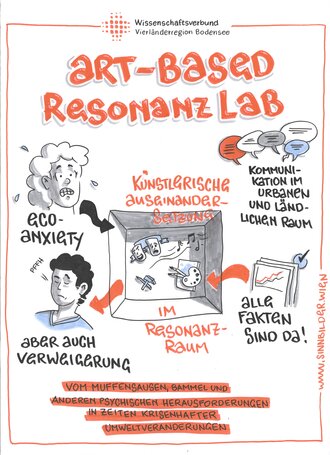
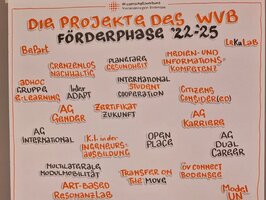
The aim of this research transfer project is to make the complex, and above all negative emotions in the context of climate change visible, expressible, researchable and usable as a starting point for collective action. To this end, a mobile Art-Based Resonance Lab is planned, which:
a) is an open space where people can examine their emotional reactions to climate change (and those of others) and are invited to engage with their relationship to nature and the climate crisis through artistic forms of expression
b) can address different target groups at different locations in the rural Lake Constance region
c) is a safe place where people are invited to open up to their (negative) emotions, can experience them as justified and appropriate (reframing) and where psychologically trained contact persons are on site to provide support
d) enables a collective space for experiencing eco-anxiety, creating a sense of community in the crisis and promoting collaboration
Approaches and methods
The interdisciplinary team aims to use the explorative and transformative power of artistic forms of expression with the help of the ResonanzLab. The project aims to open up a space that helps to overcome social speechlessness in the face of impending crisis scenarios and offers opportunities to develop or articulate collective visions. Specifically, artists will work together with people in the four-country region on how they deal with climate change. In the course of this, the ResonanzLab will explore artistic strategies and inclusive communications, shared feelings, visions and hopes that may express themselves in language and sound, call and response, echo and vibration − visually, collectively, aurally, on site and in motion.
Target group
Project partners
Funding
The project is being funded by the small project fund responsible for the scientific network, which is financed by ERDF funds from the Interreg VI “Alpenrhein- Bodensee- Hochrhein” programme as well as funds from the International Lake Constance Conference (IBK).
Further information about MoodLab: External link opens in a new window:www.resonanzlab.net.

"Coole Suppe" Film Festival
Animated film for the future – workshop in Feldberg
How do I imagine the world in 50 years? What do I want – and what might worry me?
Children aged 9 to 12 in Feldberg spent two days creatively exploring these and many other questions at the animated film workshop “Animated film for the future” in the Feldberghalle.
The first day focused on interview techniques: the children interviewed each other, filmed themselves and developed their own questions about the future – some very real, such as “Where would you like to live later?” (where lots of soccer players live) or artistic and philosophical, such as “What color is the future?” (neon green).
Then it was time for creative design: using construction paper, photos, modeling clay, and wool, the children used their imaginations to create images of the future.
Using green screen technology, the children were then able to “beam” themselves into their own images.
The aim was to give children a hands-on experience of film as a creative medium for shaping the future and to document their view of the world.
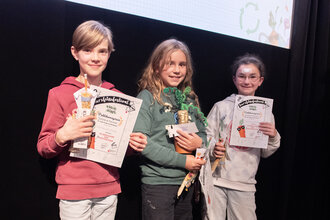
Our film “What colour is the future?” won the audience award at the “Coole Suppe” children's animated film festival!
More about the Coole Suppe Festival: https://coole-suppe.de/
![[Translate to English:] Gewinner vom Publikums-Preis](https://www.hs-furtwangen.de/fileadmin/_processed_/6/8/csm__CooleSuppeFilmfestival_2025_052_e7668b6367.jpg)
![[Translate to English:] Teilnehmende Kinder](https://www.hs-furtwangen.de/fileadmin/_processed_/1/d/csm__CooleSuppeFilmfestival_P2490466_1__c91c398c9a.jpg)
![[Translate to English:] Teilnehmende Kinder](https://www.hs-furtwangen.de/fileadmin/_processed_/b/1/csm__CooleSuppeFilmfestival_P2490467_b2123adbaa.jpg)
Your key contact
I am happy to exchange ideas on our exciting research topic.