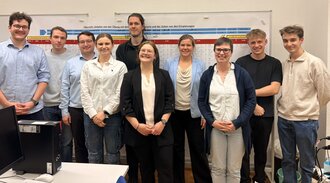
At the Regional Council in Karlsruhe
Students of the Internal link opens in the same window:Security & Safety Engineering and Internal link opens in the same window:Risk, Reliability and Safety Engineering programmes at Furtwangen University accompanied the large-scale “Interrupt 2025” staff framework exercise organised by the Karlsruhe Regional Council as external observers. The exercise focused on a simulated scenario of a large-scale power outage in the Karlsruhe administrative district, which was used to test crisis response procedures and administrative staff work.
Under the leadership of HFU employee Lena Kraibühler, the students actively supported the exercise management. Their tasks included conducting structured interviews, systematically documenting observations, and providing technical support for the exercise management.
“This was an exceptionally valuable opportunity for our students to gain realistic insight into crisis management work. Everyone was enthusiastic, because it is rare to experience administrative and crisis structures so directly and authentically,” emphasises Prof. Dr.-Ing. Marion Meinert, Professor of Security and Hazard Prevention at HFU.
The exercise was also significant from the students' perspective. Max Wieland, a student in the Security & Safety Engineering programme, evaluated the exercise as part of his bachelor's thesis: "Direct observation and analysis of the staff's work was extremely valuable for my thesis. The exercise demonstrated how complex decision-making processes are in crisis situations – and how important structured cooperation and communication are in this context," said Wieland.
The “Interrupt 2025” exercise took place at the Karlsruhe Regional Council and, as envisaged in the official exercise scenario, focused in particular on establishing the operational capability of an administrative staff, coordination between different departments, and internal and external communication within the crisis structure.
The students accompanied all relevant phases of the exercise day – from the initial assessment of the situation to several staff meetings, shift handover, and final evaluation. The insights gained are now being incorporated into the comprehensive evaluation of the exercise and will contribute to the further development of future crisis management and training processes.