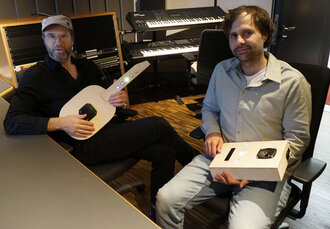
Prof. Dr. Norbert Schnell (left) and Dr. Andreas Förster with the “digital” guitars
Doctoral thesis on digital musical instruments at Furtwangen University
Not everyone can play the guitar. This is not always due to a lack of practice, but sometimes also to physical or cognitive barriers. Andreas Förster addressed this issue in his doctoral thesis, which was supervised at Furtwangen University (HFU). “I want to give everyone the opportunity to make music and be creative. Classical acoustic instruments are not barrier-free,” reports Andreas Förster. He completed his community service at a special school for mental development. Förster studied special education and music teaching, completed a master's degree in rehabilitation sciences, followed by a second degree in music design at the Trossingen University of Music, and decided to explore the topic of inclusive musical instruments in more depth in a dissertation.
“I had already worked with Andreas on a previous project, so I was happy to supervise his doctoral thesis. A tremendously fruitful collaboration developed,” reports Prof. Dr. Norbert Schnell, who oversees cooperation with the University of Music at HFU.
For his doctoral thesis, Förster first gathered information on the use of digital musical instruments in special schools. “I conducted interviews with music teachers at special schools and also carried out a survey at all special schools in twelve federal states.” The interviews revealed that instruments perceived as assistive technologies, i.e., those designed specifically for people with disabilities, are often rejected. “That's why I wanted to develop and implement the project in a participatory manner with the group from the outset,” explains Förster. To this end, he spent a year working with students at a school for physical and motor development, adapting the instruments to their needs. This is how the “digital guitar” came about. “My first prototype was a converted guitar controller for a game console, which was very well received. The chords are selected using coloured buttons, while the notes are triggered via a touch slider. This allows different notes and chords to be played intuitively,” explains Andreas Förster.
About half of the students had complex disabilities and communicated non-verbally, so Andreas Förster chose a different approach for them. "I picked up on the students' everyday movements. For example, one student always ran one hand over the back of the other, so I attached a pressure sensor there and translated this movement into sound. When we played music together, it became very clear that she was consciously interacting with it," says Förster happily.
At the beginning of December, Andreas Förster was honoured with the Gips-Schüle Foundation's Special Research Award for his extraordinary scientific work. He was nominated by Prof. Schnell, “The topic of inclusion affects all of us and fits in very well with the research topics at our university. Andreas is a great person with a broad range of knowledge who brings the necessary scientific depth to the topic without losing sight of the most important thing − the joy of making music together!” The dissertation was written in cooperation between the Technical University of Berlin and Furtwangen University.
Förster is now also involved in preparations for further projects on the topic. “I want to make the results accessible to as many people as possible, so we are currently working on bringing the guitar to market. In a second project, we want to further develop the individual instruments and design a modular system,” reports Förster.