Furtwangen University showcased in Strasbourg
Furtwangen University was represented at the first “UR Futur Festival of Technical Universities in the Upper Rhine” in Strasbourg from 5 - 7 November. As part of the festival, at the “URAI” symposium on artificial intelligence and at the interactive exhibition “UR Futur Experience,” Dr. Daniel Schönle from HFU and his team presented cutting-edge research in the field of medical AI and an Industry 4.0 demonstrator from the semester project “Smart Factory Cockpit.”
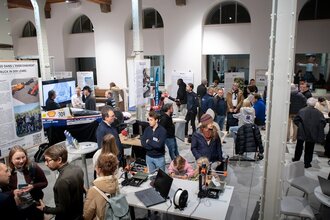
The “UR Futur Festival,” jointly organized by Alsace Tech and the TriRhenaTech Alliance, transformed Strasbourg's “Manufacture des Tabacs” into a cross-border innovation laboratory. The festival brings together universities of applied sciences and grandes écoles from the Upper Rhine region and presents technologies, prototypes, and solutions that will shape the Upper Rhine of tomorrow. Within the “UR Futur Experience” exhibition, 14 partner universities presented around 40 projects in an immersive, interactive environment. Visitors were able to learn what is taught at the partner universities by experiencing concrete demonstrators and getting to know the people behind them.
UR Futur Experience: Smart Factory Cockpit – a factory in miniature
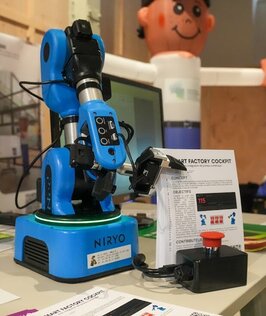
At the exhibition, Furtwangen University presented the semester project “Smart Factory Cockpit” under the direction of Dr. Schönle. He was supported at the stand by student ambassadors Nils Danton D'Souza and Nico Pergande. Together, they explained the demonstrator, invited visitors to try it out, and answered questions about studying at Furtwangen University.
The Smart Factory Cockpit addresses a key challenge of Industry 4.0. Traditional production monitoring systems often lack real-time visualisation and cannot sufficiently integrate heterogeneous data sources such as machines, sensors, and IT systems. This leads to limited transparency in complex production environments.
The project team developed an interactive monitoring system that combines:
- two cooperating robot arms
- a fully automated ordering system
- a digital twin of the plant
- a dashboard that visualises all processes in real time.
In the demonstration, coloured blocks are automatically sorted, moved, and packed into containers, from ordering to storage. Every movement of the robots, every status, and every malfunction is recorded and visualised live. This makes it possible to understand how real-world production can be monitored and optimised with modern IT. Technically, the project relies on “Eclipse BaSyx” as a platform for digital twins, “Prometheus” for collecting measurement data, ‘Grafana’ for clear real-time dashboards, and a “Docker container architecture” that makes the system flexibly scalable. All components of the physical model were manufactured in-house using 3D printing. The special design ensures that the robots can grip the parts reliably – an important aspect for robust automated processes.
The result is a fully functional demonstrator with an automated production process that clearly shows how digitisation increases transparency and efficiency in production. During the two days of the exhibition, the booth attracted many high school and college students who tested the system and watched the robot arms in action. “Many visitors were surprised that every step of the robot arms can be tracked on the dashboard – almost as if you were watching the factory think,” reports Dr. Schönle.
URAI Symposium: Clinically ready detection of label flips for medical AI
The “URAI Symposium – Artificial Intelligence in the Upper Rhine Region” also took place as part of the “UR Futur” event. On 5 November, Dr. Daniel Schönle (HFU Faculty I: Computer Science & Applications and Institute for Data Science, Cloud Computing and IT Security) presented his work “Clinical Ready Label Flip Detection for Medical AI.” The paper was co-authored with HFU Professor Dr. Christoph Reich.
The presentation focused on the key question − How can we ensure that artificial intelligence in medicine is based on accurate and reliable data? Incorrect labeling can occur in clinical data – for example, when a finding is mistakenly marked as “sick.” Such errors can distort the decisions of AI systems, worsen their predictions, and also lead to injustices between patient groups.
Dr. Schönle and his team developed a testing procedure that:
- compares the AI specifically with the available data
- automatically filters out particularly suspicious cases,
- presents doctors with a small, manageable selection for manual review
- then retrains the AI with improved data.
This keeps the workload for medical professionals low, while significantly increasing the reliability and transparency of the models. Using an example from intensive care medicine (ICU data), it was shown that the predictive quality and reliability of the models can be noticeably improved.
Promotion of study programmes and cross-border cooperation
“This festival showed today's students what the technology of the future will look like,” says Dr. Schönle. “In addition, the collaboration with the TV station Arte made it possible to experience this future practice in special workshops. I was impressed by the consistently positive attitude toward automation and artificial intelligence.”
Participation in “UR Futur” directly supports the strategic goals of Furtwangen University. The Smart Factory Cockpit Demonstrator presents project-based learning in computer science and engineering and makes complex concepts such as digital twins, time series monitoring, and container orchestration accessible to a broad audience. The presence at “UR Futur” and the “URAI Symposium” strengthens the university's visibility in the Upper Rhine innovation ecosystem and underscores its expertise in medical AI, data science, and Industry 4.0. The booth and student ambassadors provided a concrete opportunity to present study programmes to high school students, especially those from France, and highlight opportunities for a semester abroad at Furtwangen University.
“UR Futur” itself is part of the TriRhenaTech Alliance, the network of universities of applied sciences in the Upper Rhine region. Since 2022, TriRhenaTech has been organised as an association under German law and brings together 21 German, French, and Swiss institutions with more than 6,500 employees, 55,000 students and 1,600 professors.
“UR Futur is a perfect stage for what universities of applied sciences can achieve when they combine research, teaching, and practical demonstrations,” emphasises Dr. Schönle. “For our students, it was a unique opportunity to present their work to an international audience and see how their ideas fit into a larger, cross-border innovation landscape.”