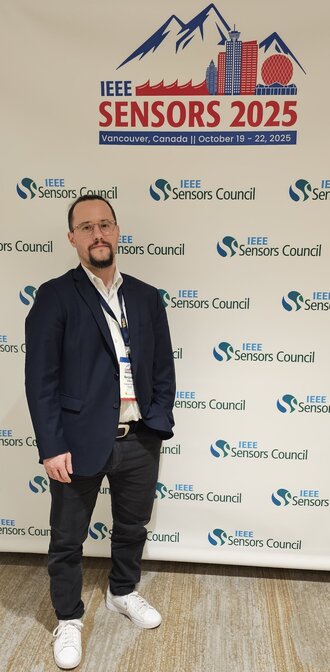
iMST presents research at IEEE Sensors in Canada
How can flexible sensors be used for cutting-edge medical applications? This is precisely the focus of the Internal link opens in the same window:Institute for Microsystems Technology (iMST) in the research project Internal link opens in the same window:DiaKat+, funded by the Federal Ministry for Research, Technology and Space. The goal is to use ultra-thin metal films on elastic silicone substrates as strain sensors in balloon catheters − enabling tactile diagnostics directly inside blood vessels.
The operating principle sounds simple but is technically fascinating − when the silicone is stretched, fine cracks form in the metal film. These alter the electrical resistance, which can then be used as a highly sensitive sensor signal. In this way, both small and large strains can be measured reliably.
To better understand exactly how these cracks form, iMST developed its own testing apparatus. It enables defined uniaxial and biaxial loads to be applied to the material composite. At the same time, the metal films are examined in high resolution using a laser confocal microscope. The testing device is an in-house development by iMST and was built together with the university’s Internal link opens in the same window:central workshop − involving extensive technical expertise and creative solutions.
The resulting research findings were recently presented by Benjamin Sittkus, a doctoral candidate at iMST, at the international IEEE Sensors conference in Vancouver. In the contribution, “Crack evolution during priming of uniaxial and biaxial loaded crack-based strain sensors,” it is demonstrated how cracks form during the initial loading and how different strain conditions influence the crack structures and the electrical behavior of the sensors. This interplay is essential for developing reliable models that can later predict sensor behavior under complex loads − for example, in the planned application for tactile vascular diagnostics.
IEEE Sensors is one of the most important conferences worldwide in the field of sensor technology and provides researchers with a platform to discuss new developments with an international audience.
The iMST contribution once again illustrates the diversity and application-driven research at HFU. Supported by the Internal link opens in the same window:Institute for Applied Research (IAF) and a research infrastructure built up over many years, solutions are being developed here that are both technically sophisticated and socially relevant.