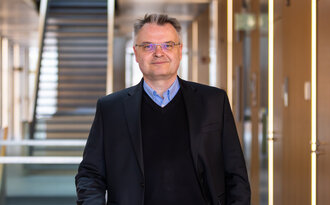
Prof. Dr. Steffen Thiel has been Dean of the Faculty of Computer Science & Applications at HFU since March 2025.
Interview with Dean Prof. Dr. Steffen Thiel
Furtwangen University is currently undergoing a period of great change! One outward sign of this is that the previous nine faculties at HFU have been merged into four larger units. One of these is Faculty I: Computer Science & Applications.
Prof. Dr. Steffen Thiel has been Dean of the faculty since March. We spoke to him about the restructuring, his experiences over the past few months, and his goals for the future.
Professor Thiel, how have you been getting on with the new large Faculty of Computer Science & Applications over the past few months?
The first few months were intense – but also very motivating. The reorientation of a young faculty involves many structural, organisational, and content-related tasks. At the same time, there was a palpable sense of optimism. It is a special moment to be creating something new together with colleagues from four former faculties.
What were the major tasks that needed to be accomplished first?
First of all, I am very pleased that we were able to recruit such a committed and experienced dean's team that brings different perspectives to the table. As a first step, we merged central structures and exploited synergies—for example, in administrative processes, laboratory infrastructure, and marketing. Another task was to reorganise the work of the committees. At the same time, we established communication channels to provide guidance and transparency for all those involved in the change process.
What tasks are on the agenda in the short and medium term?
In the short term, the focus is on consolidating our degree programmes − we are developing and bundling bachelor's and master's programmes based on common subject profiles and clear areas of expertise. This also includes taking a closer look at the entire student lifecycle − from initial contact to the alumni network − and expanding the existing support services in a targeted manner. In the medium term, we want to network research activities more closely, develop new cooperation formats for industry partners, and thus raise the profile of our programmes in the long term.
What else do you think needs to be on the agenda?
We must continue to work on bringing the new faculty closer together culturally. This means establishing exchange formats, highlighting common themes, and, more specifically, creating spaces for encounters. In addition, strategic positioning in the areas of internationalisation, transfer, and continuing education will become increasingly important.
Where do you see the advantages and disadvantages of the new organisational structure?
One clear advantage is that we can work more interdisciplinarily in a larger faculty with diverse profiles − especially at the interfaces of computer science, business, technology, and media. The new structure also allows us to use resources in a more targeted manner and bundle processes. The challenge lies in leveraging this potential without losing sight of the respective subject identity. This requires open communication, participation, and trust.
What changes do you expect this to bring for teaching?
I see great opportunities for interdisciplinary topics, new areas of specialisation, and innovative formats that offer students more creative freedom. Joint teaching concepts, for example in the area of hybrid teaching, can now also be better anchored across faculties. The larger organisational unit also opens up new opportunities for project and elective courses.
What about research?
Here, we want to make targeted use of synergies and increase our visibility, for example through joint research clusters, closer cooperation in research groups, cooperative doctorates, and systematic acquisition of third-party funding. The transfer of knowledge into practice will also play a greater role in the future.
The interview was conducted by Prof. Jörg Jacobi.