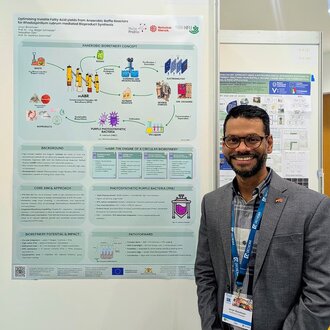
Urvyn Boochoon with his poster at the European Federation of Chemical Engineering (EFCE) Congress in Lisbon
Impressions of the "Engineering for a Sustainable World" Congress in Lisbon
Armed with the very latest research findings, doctoral students Jessica Jung-Fittkau (Prof. Magnus Schmidt's research group, Faculty III) and Urvyn Boochoon (Prof. Holger Schneider's research group, Faculty III) represented HFU at the “Engineering for a Sustainable World: Summit for Clean Technologies & Brighter Legacy,” which took place from 8 - 10 September in Lisbon, Portugal.
The international conference brought together three major specialist events – the 15th European Congress on Chemical Engineering (ECCE), the 8th European Congress on Applied Biotechnology (ECAB) and the 3rd Ibero-American Congress on Chemical Engineering (CIBIQ) – and provided an interdisciplinary platform for the exchange of ideas on sustainable technologies. The focus was on innovative approaches from chemical engineering, biotechnology, and bioprocess engineering that aim to contribute to solving global challenges.
“This congress was particularly interesting because of the breadth of high-quality research work,” says Boochoon, “and I appreciate the opportunity to collaborate with researchers from all over the world.” His own poster presentation, in which Boochoon presented data from his work in the project “Model-Based Design of Processes for the Bioeconomy (MoDeProBio),” also met with great interest. This project is developing new ways to make biological processes more sustainable. One example of this is the use of digital twins in the design of processes that can quickly and efficiently convert waste materials into energy or usable bioproducts.
Jessica Jung-Fittkau, who is doing her doctorate at HFU as part of a collaboration with the University of Hohenheim (Prof. Dr. Andrea Kruse), is working on the Vector Foundation-funded “PepKatCO2” project to create a library of peptides (small protein molecules) using a combinatorial approach and to investigate whether they can bind CO2 – with the aim of not only binding CO2, but also making it usable as a resource. She also presented her results on a poster.
“The technical presentations and discussion rounds made it clear that the capture, use, and storage of CO2 is an indispensable technology for achieving the climate targets by 2050,” says Jung-Fittkau. “This is particularly important in emission-intensive sectors such as the cement, chemical, and energy industries.” In addition to technological advances, political framework conditions and social acceptance also play a decisive role in the widespread implementation of the technology, she adds.
Fresh from Lisbon, Boochoon sums up the conference thus, “Conferences like this strengthen cooperation between science and industry and accelerate progress in building a circular bioeconomy.”
The MoDeProBio project is funded by the Programme for Applied Sustainability Research at Baden-Württemberg Universities of Applied Sciences “PAN HAW BW” and co-funded by the European Union (ERDF Programme 2012-2027).
The PepKatCO2 project – Catalytic CO2 processing using transition metal binding to peptides – is funded by the Vector Foundation (P2021-0138).