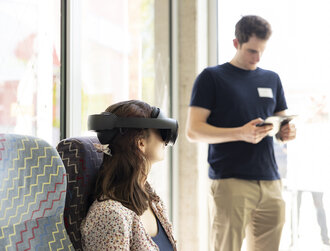
IIIUS has already gained experience with trade fair visitors in XR environments in order to evaluate the effect of the VR robot on users. Photo: AEN
In the regioKArgoTramTrain project, the IIIUS Institute is researching the integration of autonomous logistics solutions with extended reality.
The Institute for Intelligent Interactive and Ubiquitous Systems (IIIUS) at Furtwangen University is working on the “regioKArgoTramTrain” research project to develop and test new concepts for parcel delivery in urban areas. The aim is to find solutions to the challenges posed by increasing delivery traffic and to reduce traffic congestion through innovative technological approaches.
The focus is on the use of autonomous delivery robots that use public transport to deliver parcels more efficiently and sustainably. In addition to technical development, IIIUS is investigating suitable communication methods for human-robot interaction (MRI), developing user-friendly graphical user interfaces, and evaluating the acceptance of such systems among passengers.
Eight different methods of interacting with the delivery robots were evaluated in a focus group with 18 participants from industry and research. These included interactive displays on the robot platform, gesture control, LED strips on robots and packaging units, trajectory projections, and voice interaction and output. The tests were conducted in a tram model to realistically represent the context of public transport.
The results of the focus group show a fundamentally positive attitude toward the MRI methods tested. Participants evaluated the approaches from various perspectives, including simplicity, readability, appeal, and conspicuousness.
In addition, real prototypes and extended reality (XR) scenarios are being used in the project to further investigate the impact of delivery robots on passengers. XR technology makes it possible to simulate and test different situations flexibly and mobile at various locations. For example, in May and September 2025, XR test environments were set up in Karlsruhe and at Albtaler Verkehrsgesellschaft (AVG), where trade fair visitors could experience interaction with the delivery robots and describe their impressions.
Further tests in XR environments are planned for the coming months, incorporating eye tracking and controlled test setups. The findings will help to further optimise human-robot interaction in the context of parcel delivery and increase acceptance among passengers.