International collaboration for the development of novel metasurfaces
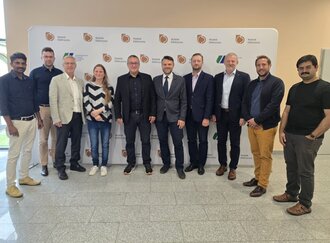
As part of the binational project MagMetaSurf ("Investigation of Electromagnetic Properties of Terahertz Metasurfaces Tunable by Multidirectional Magnetic Fields"), a delegation from the research group of Prof. Bucher and Prof. Mescheder visited the West Pomeranian University of Technology in Szczecin (ZUT), Poland. There, they met for two days with Prof. Dr. Przemysław Łopato and his team from the Center for Electromagnetic Fields and High-Frequency Technology in the city of Szczecin.
The aim of the MagMetaSurf project is to develop novel terahertz sensors based on metasurfaces, which are manufactured using MEMS technologies and can be precisely tuned by applying magnetic fields. Such sensors offer a wide range of applications in the fields of wireless communication, imaging, security solutions, selective absorber structures, and polarization filters. The project work is highly interdisciplinary, combining expertise from electromagnetism, mechanics, materials science, and microsystems engineering. MagMetaSurf is funded over a three-year period by the German Research Foundation (DFG) (grant number ME 2093/9-1) and the National Science Center (NCN) in Poland (grant number: 2022/47/I/ST7/02055).
During the meeting in Szczecin, two main topics were in focus. First, the current status of the project was discussed, particularly the fabrication and characterization of the first test samples. This was followed by a scientific exchange on metasurface design, constructive details, and planning for the manufacturing of the first design concept as well as upcoming tasks in the course of the project.
Secondly, opportunities for further collaboration in the field of flexible terahertz sensors and potential joint project proposals were explored. Both research groups are already working intensively on the simulation and fabrication of corresponding structural prototypes and complement each other exceptionally well in their areas of expertise.
Current results of the project were presented at the Eurosensors Conference 2025 in Wrocław (Poland) and will be published at the MST Congress 2025 in Duisburg.