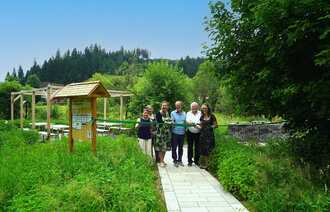
Cornelia Bohnet, Prof. Dr. Nicole Weydmann, HFU Head of Admin. Andrea Linke, Michael Schätzle, Managing Director of DreiGe and landowner, Manfred Kühne, Deputy Mayor and Dean Prof. Dr. Margareta Müller (all from left) ceremoniously opened Furtwangen University's newly created campus garden together.
Furtwangen University inaugurates campus garden - pioneering work in teaching Planetary Health
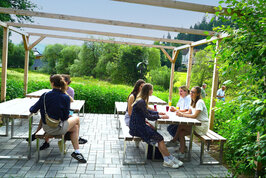
Furtwangen University (HFU) has added a very special area to its campus in Furtwangen − the “Campus Garden” behind the university's O Building (former hospital) was officially opened on Tuesday. “Two areas have been created here,” explained Prof. Dr. Margareta Müller, Dean of the Faculty of Health, Medical & Life Sciences, in a short speech. On the one hand, a “green learning oasis” has been created for students, and on the other, a herb garden where medicinal plants are grown. A barefoot path also ensures that breaks can be made particularly relaxing. “The topic of health is extremely important to us at HFU,” emphasised Head of Administration Andrea Linke at the opening. “A healthy social space has been created here for staff and students alike, where they can experience what defines us as a university − community in the midst of beautiful nature!”
The campus garden is also to be made accessible to other user groups, such as kindergartens and schools or interested passers-by. Students of the Applied Health Sciences bachelor's degree programme designed the campus garden and eagerly picked up shovels and hoes to plant the garden themselves. Coordinated by Cornelia Bohnet from HFU, the campus garden was realized with the support of many sponsors such as the city of Furtwangen, the companies DreiGe, STARK, ZG Raiffeisen, Ganter Norm, Schwer Garten- und Landschaftsbau, Birkenmaier, Volksbank Mittlerer Schwarzwald, AOK as well as Scherer Bau GmbH and Zimmerei Patrick Wölfle.
The campus garden project was initiated by Prof. Dr. Nicole Weydmann, who has anchored the topic of “Planetary Health” at HFU. Furtwangen University is a pioneer in Germany, Austria and Switzerland and the first institution to integrate the topic into its teaching.
At HFU, students from various disciplines study the interactions between human health and the ecological limits of our planet in four study modules. Professor Weydmann designed the new teaching content; the psychologist teaches on the “Applied Health Sciences” course at HFU, among others.
After the foundation courses, students can choose between the two exciting specialisations “Digital Health” and “Planetary Health”. “We want our students to understand that health doesn't happen in a vacuum,“ she explains. ”When we talk about environmental pollution, global warming or biodiversity loss, we're also talking about disease patterns, gaps in care − and ultimately about justice.”
The planet as a patient
Planetary health is a relatively new concept that is becoming increasingly urgent. It describes the close connection between human health and the state of the Earth's natural systems. The World Health Organisation (WHO) has been warning about the health consequences of the climate crisis for many years. These include heat waves, air pollution and the spread of new infectious diseases.
Furtwangen University is going one step further: the focus is not only on the risks, but above all on the role of the healthcare systems themselves − both as those affected and as contributors. “We talk a lot about CO₂, but less about what flows out of the clinics − problematic wastewater, medicines in rivers, hazardous waste, tons of disposable materials,” says Weydmann. “The healthcare industry needs to become more sustainable, and we want our students to be able to play an active role in this.”
Education for a healthier future
In the four modules, students learn in a practical and interdisciplinary way. They deal with the ecological footprint of hospitals, sustainable nursing practice, environmental psychology and also politics and economics. “The current crises in the world clearly show that resources are always at stake, for example access to water, food and, in this sense, health,” says Weydmann.
HFU's awareness of planetary health is reflected in a wide range of projects, such as the new campus garden. “Our vision is that everyone who starts their career with us is not only professionally fit, but also thinks about planetary connections,” says Weydmann. “Because the patients of the future will bring new problems with them − asthma caused by particulate matter, psychological stress caused by heat stress, antibiotic resistance from factory farming.”
Pioneering role with responsibility
Planetary health is not yet a standard in teaching − but perhaps that is only a matter of time. Many students see the fact that Furtwangen University is leading the way here as an opportunity, but also as a mission. The message is clear − if we want to safeguard the health of future generations, we need to change our way of life and our economy − and our healthcare system at the same time. Planetary health is not a fancy extra, but a necessary component of modern health education. “In the end,” Nicole Weydmann sums it up, “it's always about caring − for people, for communities, for our planet.”
Prospective students have until 15 July to apply for a place at Furtwangen University for the coming winter semester: Internal link opens in the same window:https://www.hs-furtwangen.de/en/