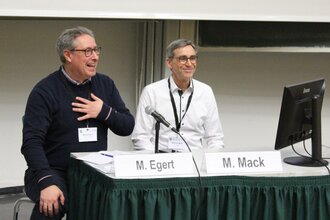
Prof. Dr. Markus Egert from HFU and Prof. Dr. Matthias Mack from Mannheim University of Applied Sciences are involved in a network for microbiological research. Pictures: Störiko/VAAM
Kick-off meeting for the establishment of a network for microbiological research at universities of applied sciences
In nature, microorganisms such as bacteria and fungi like to live in large communities. They benefit from the diverse abilities of their partners, for example when it comes to protecting themselves from enemies or breaking down complex food sources.
It also makes sense for (human) microbiologists conducting research at universities of applied sciences (HAW) to be part of a larger community. Modern research questions can only be answered comprehensively in consortia, many funding programmes already require the cooperation of several groups, sometimes across state borders, and the acquisition and maintenance of complex large-scale equipment is often too expensive for a single group or university.
With currently around 3,500 members, the Association for General and Applied Microbiology (VAAM; www.vaam.de) is the largest microbiology-oriented specialist society in the German-speaking world, and has been for 40 years. Together with Prof. Dr. Matthias Mack from Mannheim University of Applied Sciences, Prof. Dr. Markus Egert, Faculty of Health, Medical & Life Sciences and member of the Advisory Board of the VAAM Executive Committee, has now launched an initiative to better network the microbiological HAW research groups in the VAAM.
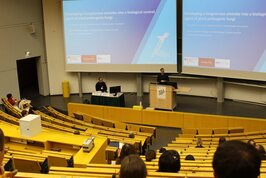
As part of the VAAM annual conference, which took place this year from 23 to 26 March at the Ruhr University in Bochum, the two organised a session with exciting contributions from HAW research. The speakers came from the universities in Mannheim, Erfurt, Coburg and Wismar and addressed topics as diverse as biotechnological vitamin production with blue-green algae, the stimulation of crop growth by soil bacteria, the micro-ecological environmental impact of facade coatings and the use of amoebae against fungi for plant protection. Common to all topics was a clearly recognisable application reference. With up to 60 listeners, this first-time event was very well attended.
In the concluding overall discussion, the idea of retaining this format for future annual conferences and holding a nationwide networking meeting of all HAW groups working on applied microbiology was very much welcomed. Mannheim University of Applied Sciences is a suitable venue due to its central location and good accessibility. In addition to HAW research groups, small and medium-sized companies with microbiological R&D activities, for which cooperation with universities is often challenging, should also be invited.
Those interested should contact Matthias Mack (Email application is started:m.mack(at)hs-mannheim.de) or Markus Egert (Email application is started:markus.egert(at)hs-furtwangen.de).