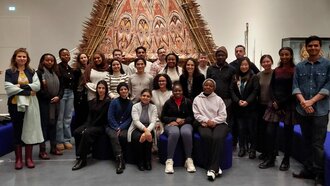
Students in the “International Relations and Cultural Diplomacy” program experience the Humboldt Forum Berlin as a place of learning with Prof. Dr. Julika Baumann Montecinos.
Berlin master's programmes enter the next round. Students from all over the world qualify in the field of international relations and business
With the Senate's final decisions on re-accreditation, the two study programmes “International Economics, Business and Cultural Diplomacy” and “International Relations and Cultural Diplomacy” will enter a new era from Winter Semester 2025/26. New modules and content have been added and existing focus areas and structures have been further developed.
The partnership, which has been running successfully for ten years, has since produced over 500 graduates from HFU. The young people come to Berlin from all over the world to work on the campus of the cooperation partner, the Institute for Cultural Diplomacy (ICD), with lecturers from HFU Faculty IV. The cohorts are characterised by great cultural diversity and internationality. So far, students from a total of 91 different countries have completed the programme. The core of this success is the productive cooperation between the two partners HFU and ICD − HFU contributes the high quality and international experience of its teaching staff and ICD its large, global network of organisations and diplomatic services. Entry is possible in both the winter and summer semesters.
The content of the master's programmes fits into today's dynamic world situation with its many crises, conflicts, but also opportunities, and thus addresses the need to build new cooperation structures. They enable students from various disciplines to deepen and further professionalise their skills in the areas of international business, politics and culture. This prepares them for the complex challenges of the globalised and networked economy and society of the 21st century.
The study programmes focus on concepts and methods of “cultural diplomacy” and the dimensions of “soft power”, which aim to stabilise and shape political, economic and social relationships. The know-how acquired is in tune with the times and thus makes a contribution to human security and international peace that should not be underestimated.