
People shape the future
A degree programme that combines interactive formats, real-world projects and personalised supervision – always with a strong degree of practical relevance. Thanks to the flexible blended-learning approach, the programme can be tailored to suit individual circumstances, whether you’re balancing work, family commitments or living abroad.
In small groups, students undertake practice-oriented projects, supported by lecturers who work with them as equals. On-campus sessions in Aalen and Furtwangen provide opportunities for discussion, teamwork and prototyping, complemented by digital tools and virtual study spaces.
The programme adapts to your personal circumstances and creates the ideal framework for individual development.
Your key contact
I’m happy to help with any questions you have about the degree programme!

Dean of Studies:
Online Media (BSc) (OMB)
Media Design (BA) (MKB)
Course content and structure
Human-Centred Design is more than just a degree programme – it’s a mindset
Design changes the world – and it starts with people. On the master's degree programme in Human-Centred Design, you will deepen the knowledge gained during your Bachelor’s degree and apply it in new contexts in a targeted manner − interdisciplinary, project-based and future-oriented.
The degree programme is aimed at designers, developers, UX professionals, digital strategists and anyone who wishes to play a responsible role in shaping human-technology interaction. The degree programme is particularly well-suited to those who are already working on projects, managing a family or facing other specific life circumstances.
Thanks to the blended learning format, which combines digital learning phases with compact on-campus sessions, the programme can be easily reconciled with a variety of lifestyle and work arrangements. The programme offers flexibility whilst facilitating intensive, practical collaboration – both on-site in Aalen and Furtwangen, and virtually.
Entry requirements
- A completed university degree (bachelor's degree or Diplom) comprising a minimum of 210 ECTS credits and a minimum grade of 2.5
- A minimum of 90 ECTS in a design-related degree programme (e.g. Information Design, UX, Media, Communication, Technology)
- Excellent German language proficiency (C1 level)
- Participation in an aptitude test
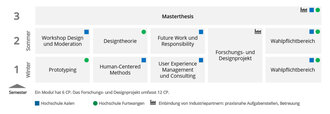
What's covered
Your career prospects
Graduates of the master's degree programme in Human-Centered Design are exceptionally well equipped to tackle complex challenges at the intersection of design, technology and society – strategically, creatively and responsibly.
The following are examples of such innovation-oriented career fields:
- UX design and user-centred research
- Product and service development
- Strategic user experience management
- Innovation and transformation consultancy
- Interdisciplinary project and team management
- Applied research and science
- Companies, agencies and public organisations