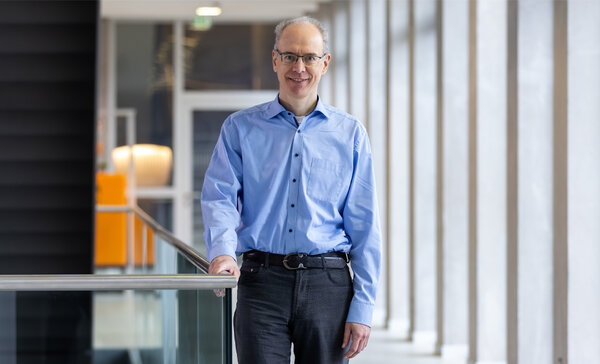
Further information
Curriculum Vitae
Professional career
- Since 09/2016
Professor of Medical Technology, Furtwangen University
Scientific Director of the Innovation and Research Center Tuttlingen (IFC) at Furtwangen University
- 06/2003 – 08/2016
Software Engineer, Software Project Manager, Research Manager, Senior Project Manager, Manager R&D, Brainlab AG
Main areas of focus: Medical navigation systems, hip, shoulder, spinal, and trauma surgery, medical product development and approval, algorithm development and optimization, clinical validation, supervision of national and international research projects, patent management
- 03/1996 – 05/2003
Technical/scientific assistant, University of Karlsruhe, Institute for Algorithms and Cognitive Systems
Main areas of focus: Medical imaging and image processing, signal transformations, motion analysis, medical data security
Qualifications
- Doctor of Engineering (University of Karlsruhe, 2002)
Thesis: “Modality-specific processing of medical image data” - Diploma in Computer Science (University of Karlsruhe, 1995)
Field of research and / or teaching
- Data analytics and artificial intelligence (AI) in medicine
- Regulatory science/regulatory issues relating to medical devices – with a focus on AI-based systems, validation, and quality assurance
- Medical navigation systems
- Medical imaging and image processing
- Analysis of human movements
- Statistics and fundamentals of information theory systems
- Innovation and start-up support
Projects
- DATIpilot Innovation Community DIIC (Digital Integration and Innovation in Surgery) - https://diic-community.de/
Network for the development and demonstration of innovative solutions in the field of digital technologies in the operating room environment based on open integration concepts and for transfer into clinical practice.
Cooperation with Reutlingen University, Tübingen University Hospital, BioMedTech e.V., and other partners/members of the Innovation Community.
Funded by the Federal Ministry of Research, Technology, and Space (BMFTR) as part of the DATIpilot Innovation Communities programme. - KTUR² (Knowledge Transfer Upper Rhine) – boosting trinational innovation – https://ktur.eu/en/home/
Cooperation between 12 academic partners in the Upper Rhine region (including the University of Basel, the University of Freiburg, the University of Strasbourg, KIT, etc.) to develop and strengthen the trinational innovation ecosystem in the region. Networking and targeted expansion of activities in the field of knowledge and technology transfer
Funded by the EU Interreg-Oberrhein programme - Medical Solution Center/CASE4Med (Computer-assisted Solution Engineering for Medical) – www.case4med.de
Network for the increased use of technologies in the field of simulation/high-performance computing and data analytics/AI in the field of medical technology and biotechnology applications
Cooperation with Medical Mountains, the High Performance Computing Center Stuttgart (HLRS), and Sicos BW GmbH
Funded by the Ministry of Science - KISS (Artificial Intelligence Services and Systems), sub-area “Smart Health” – https://projekt-kiss.net
Systematic expansion of teaching initiatives in the field of AI, including the teaching of fundamental knowledge and skills for the application-oriented implementation of AI-based systems
Cooperation with the Trossingen University of Music
Funded by the Federal Ministry of Research, Technology, and Space (BMFTR) and the Ministry of Science, Research, and the Arts (MWK) of Baden-Württemberg - Black Forest entrepreneurial spirit as part of the INSPIRE-BW Hubs – https://www.hs-furtwangen.de/en/news/detail/1325-promoting-a-start-up-culture-strengthening-the-regional-economy
Ecosystem for the development of start-up activities in southwestern Baden-Württemberg, including knowledge transfer, awareness raising, support, and promotion of start-up projects. Black Forest Entrepreneurial Spirit is one of six INSPIRE-BW Hubs that performs this function in cooperation with the Start-up Factory NXTGN in Baden-Württemberg.
Funded by the Baden-Württemberg Ministry of Science, Research, and the Arts (MWK) as part of the INSPIRE-BW Hubs programme - startUPspace@HFU in the StartupLab@FH programme – https://www.forschung-haw.de/fachhochschulen/shareddocs/projekte/de/startuplabfh/startupspace-hsu_313.html
Project to support start-up ideas in the early stages through targeted support for implementation through to prototype development – including the provision of makerspaces and creative rooms.
Publications
Haimerl, Martin
2026 | |||
| Martin Haimerl, Michael D'Agosto, Mike Fornefett, Massimo Kubon, Thomas Schiepp | Deficiencies of the EU Medical Device Regulation when applying its own rules | Frontiers in Medicine, Vol.12.2026, 2026 | BibTeX | RIS | DOI | URN |
2025 | |||
| Sergio Genovesi, Martin Haimerl, Iris Merget, Samantha M. Prange, Otto Obert, Susanna Wolf, Jens Ziehn | Evaluating Dimensions of AI Transparency : A Comparative Study of Standards, Guidelines, and the EU AI Act | Symposium on Scaling AI Assessments (SAIA 2024), September 30–October 1, 2024, Cologne, Germany, pp. 10:1-10:17, 2025 | BibTeX | RIS | DOI | URN |
| Martin Haimerl, Christoph Reich | Risk-based evaluation of machine learning-based classification methods used for medical devices | BMC Medical Informatics and Decision Making, Vol.25.2025, 2025 | BibTeX | RIS | DOI | URN |
| Julius Wiggerthale, Christoph Reich, Martin Haimerl | Uncertainty Quantifying Neural Network - Learning Uncertainty Estimates from Monte Carlo Dropout | 2025 10th International Conference on Machine Learning Technologies (ICMLT 2025), May 23-25, 2025, Helsinki, Finland, pp. 158-165, 2025 | BibTeX | RIS | DOI |
2024 | |||
| Martin Haimerl, Andreas Wierse | 5 Schlüsselfaktoren für zuverlässige Ergebnisse und kürzere Entwicklungszeiten | DeviceMed : das Community-Portal, 2024 | BibTeX | RIS |
| Julia Ott, Andreas Preißer, Harald Unterweger | AI meets Medtech – Positionspapier zu den (Heraus-)Forderungen im Bereich KI-basierter Medizinprodukte | Bayern Innovativ: Nürnberg, 2024 | BibTeX | RIS |
| Martin Haimerl | Sauberkeit garantiert : Reinigungssimulation für die Medizintechnik | DeviceMed : das Community-Portal, 2024 | BibTeX | RIS |
| Martin Haimerl | Statistische Simulationen zur Optimierung von Testergebnissen | Innovation Forum Medizintechnik, TechnologyMountains, 17. Oktober 2024, Tuttlingen, Germany, 2024 | BibTeX | RIS |
2023 | |||
| Martin Haimerl, Iman Nebel, Alina Linkerhägner, Jürgen Konradi, Claudia Wolf, Philipp Drees, Ulrich Betz | Consistency of vertebral motion and individual characteristics in gait sequences | Human Movement Science, 87.2023(February), 2023 | BibTeX | RIS | DOI |
| Martin Haimerl | Der AI Act - Europa auf dem Weg zu einem Gesetz zu künstlicher Intelligenz | Künstliche Intelligenz managen und verstehen : Der Praxis-Wegweiser für Entscheidungsträger, Entwickler und Regulierer, Beuth: Berlin, pp. 237-254, 2023 | BibTeX | RIS |
| Martin Haimerl, Alina Linkerhägner, Jürgen Konradi, Claudia Wolf, Philipp Drees, Ulrich Betz | Dynamic surface topography data for assessing intra- and interindividual variation of vertebral motion | Data in Brief, 48.2023(June), 2023 | BibTeX | RIS | DOI | URN |
| Gerhard Runze, Martin Haimerl, Marc Hauer, Taras Holoyad, Otto Obert, Henrich Pöhls, Rustam Tagiew, Jens Ziehn | Ein Werkzeug für eine gemeinsame KI-Terminologie - Das AI-Glossary als Weg aus Babylon | JavaSpektrum, 30.2023(3), pp. 42-46, 2023 | BibTeX | RIS |
| Martin Haimerl | Kl-basierte Medizinprodukte : Darstellung der Konformitätsbewertung anhand eines Beispiels | Künstliche Intelligenz managen und verstehen : Der Praxis-Wegweiser für Entscheidungsträger, Entwickler und Regulierer, Beuth: Berlin, pp. 255-282, 2023 | BibTeX | RIS |
| Martin Haimerl | Normung künstlicher Intelligenz | Künstliche Intelligenz managen und verstehen : Der Praxis-Wegweiser für Entscheidungsträger, Entwickler und Regulierer, Beuth: Berlin, pp. 209-236, 2023 | BibTeX | RIS |
| Martin Haimerl, Christoph Reich | Risk-based Evaluation of ML Classification Methods Used for Medical Devices | Research Square, 2023 | BibTeX | RIS | DOI | URN |
2022 | |||
| Martin Haimerl, Iman Nebel, Alina Linkerhägner, Jürgen Konradi, Claudia Wolf, Philipp Drees, Ulrich Betz | Comprehensive visualization of spinal motion in gait sequences based on surface topography | Human Movement Science, 81.2022(February), 2022 | BibTeX | RIS | DOI |
| Deutsche Normungsroadmap Künstliche Intelligenz | 2022 | BibTeX | RIS | |
| Martin Haimerl | Höchstleistungsrechnung für die Medizin | 2022 | BibTeX | RIS |
| Martin Haimerl | Risk-based Assessment of ML-based Medical Devices | The Upper-Rhine Artificial Intelligence Symposium UR-AI 2022 : AI Applications in Medicine and Manufacturing, 19 October 2022, Villingen-Schwenningen, Germany, pp. 146-150, 2022 | BibTeX | RIS | URN |
| Ralf Schneider, Martin Haimerl | Virtuelle klinische Studien – hilfreiche Abkürzungen auf dem Weg der Produktentwicklung | iNNOVATION FORUM Medizintechnik, #innoforum2022, TechnologyMountains, 20. Oktober 2022, Tuttlingen, Germany, 2022 | BibTeX | RIS |
2020 | |||
| Martin Haimerl | Validation of Continuously Learning AI/ML Systems in Medical Devices – A Scenario-based Analysis | Artificial Intelligence - Research Impact on Key Industries : The Upper-Rhine Artificial Intelligence Symposium UR-AI 2020; Collection of Accepted Papers of the Canceled Symposium Karlsruhe, 13th May 2020, pp. 54-65, 2020 | BibTeX | RIS |
2019 | |||
| Martin Haimerl | Current regulatory issues of AI in the field of medical technology | Artificial Intelligence: From Research to Application: The Upper-Rhine Artificial Intelligence Symposium UR-AI 2019, March 13th, 2019, Offenburg, Germany, pp. 31-36, 2019 | BibTeX | RIS |
| Martin Haimerl | Künstliche Intelligenz in der Medizintechnik – Rahmenbedingungen und Strategien | iNNOVATION FORUM Medizintechnik, TechnologyMountains, 24.Oktober 2019, Tuttlingen, Germany, p. 29, 2019 | BibTeX | RIS |
2016 | |||
| Edward T. Davis, Prakash Palaparthy, Gemma M. Smith, Mario Schubert, Melanie Wegner, Martin Haimerl | The Construction of the Anterior Pelvic Plane using Landmarks Accessible in the Lateral Decubitus Position during Computer Assisted Hip Arthroplasty | Journal of Computer Engineering & Information Technology, 5.2016(1), 2016 | BibTeX | RIS | DOI |
2015 | |||
| Edward T. Davis, Mario Schubert, Melanie Wegner, Martin Haimerl | A new method of registration in navigated hip arthroplasty without the need to register the anterior pelvic plane | The Journal of Arthroplasty, 30.2015(1), pp. 55-60, 2015 | BibTeX | RIS | DOI |
2012 | |||
| Martin Haimerl, Mario Schubert, Melanie Wegner, Sabine Kling | Anatomical relationships of human pelvises and their application to registration techniques | Computer Aided Surgery, 17.2012(5), pp. 232-239, 2012 | BibTeX | RIS | DOI |
| Tobias Renkawitz, Martin Haimerl, Lars Dohmen, Michael Woerner, Hans-Robert Springorum, Ernst Sendtner, Guido Heers, Markus Weber, Joachim Grifka | Development and evaluation of an image-free computer-assisted impingement detection technique for total hip arthroplasty | Proceedings of the Institution of Mechanical Engineers, Part H: Journal of Engineering in Medicine, 226.2012(12), pp. 911-918, 2012 | BibTeX | RIS | DOI |
| Tobias Renkawitz, Martin Haimerl, Lars Dohmen, Sabine Gneiting, Philipp Lechler, Michael Woerner, Hans-Robert Springorum, Markus Weber, Patrick Sussmann, Ernst Sendtner, Joachim Grifka | The association between Femoral Tilt and impingement-free range-of-motion in total hip arthroplasty | BMC Musculoskeletal Disorders, Vol.13.2012, 2012 | BibTeX | RIS | DOI |
2011 | |||
| Tobias Renkawitz, Martin Haimerl, Lars Dohmen, Sabine Gneiting, Melanie Wegner, Nicole Ehret, Claudia Buchele, Mario Schubert, Philipp Lechler, Michael Woerner, Ernst Sendtner, Tibor Schuster, Kurt Ulm, Robert Springorum, Joachim Grifka | Minimally invasive computer-navigated total hip arthroplasty, following the concept of femur first and combined anteversion: design of a blinded randomized controlled trial | BMC Musculoskeletal Disorders, Vol.12.2011, 2011 | BibTeX | RIS | DOI |
2010 | |||
| Tobias Renkawitz, Melanie Wegner, Sabine Gneiting, Martin Haimerl, Ernst Sendtner, Thomas Kalteis, Joachim Grifka | Experimental validation of a pinless femoral reference array for computer-assisted hip arthroplasty | Journal of Orthopaedic Research, 28.2010(5), pp. 583-588, 2010 | BibTeX | RIS | DOI |