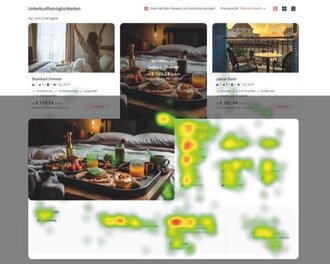
Clearly visible in the eye tracking analysis - emotional images draw attention to the travel information rather than the price. Hotel rooms presented in this way are booked with corresponding enthusiasm.
New research project at Furtwangen University investigates the influence of emotions on hotel bookings
The latest collaboration between Furtwangen University (HFU) and Frankfurt-based IT company GauVendi demonstrates how companies can benefit directly from research conducted at HFU. In a joint research project, HFU professor Dr. Kai-Markus Müller and his partner company investigated how emotional priming affects users of hotel booking websites. “Emotional priming describes a process in which the emotional response to an initial stimulus influences the processing and response to a subsequent, related stimulus. This method is used in psychological research. Here, we used it to address consumers' feelings in order to find out whether this influences their purchasing decisions,” explains Müller.
In the research project, Müller and his team, together with their partner company GauVendi, were able to demonstrate how strongly emotional product presentations — in this case, specially prepared images of hotel rooms — lead to increased booking rates. “By analysing eye movements and reactions to emotional and neutral hotel room images, we found that emotional representations such as sun-drenched rooms in warm colors can successfully divert viewers' attention from prices to the special features and unique charm of the rooms,” reports Müller. He led the study as project supervisor at Furtwangen University, where he and a dedicated team of four business psychology students used eye tracking to observe test subjects during the booking process on specially prepared websites.
In his study, Müller observed that the effect is even stronger for more expensive room categories — the more emotional the imagery, the less attention is paid to a higher price. “In fact, in addition to eye tracking, data from GauVendi has also shown that booking rates increase with more emotional hotel room images and names,” says Professor Müller. Images such as sunsets or impressive views also remained in the memory of bookers much longer. When it came to the names of room categories, it was clear that potential overnight guests like to be addressed on an emotional level, “Cozy relaxation” is more likely to be booked than a “standard room.”
“The results of our study are a clear call to hoteliers to use the power of emotion in their marketing strategies,” says Müller, who teaches and researches consumer behavior at HFU and is the dean of the Business Management and Psychology programme.
In addition, Müller maintains close ties with the industry, both in tourism as Chief of Behavioral Strategy at the Innsbruck-based hotel software company RateBoard and in applied neuroscience research as Director of Pricing Research at Neurensics in Amsterdam.
The study is available at the following link:https://hubs.ly/Q02wTdjb0.