Insights from the CoHMed Final Symposium
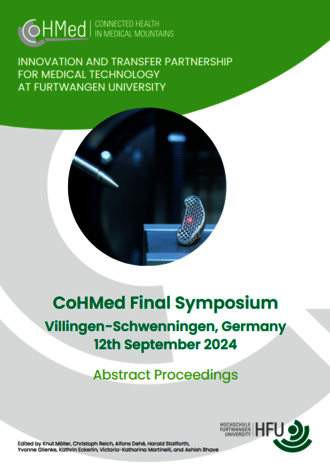
Artificial intelligence, personalised implants and digitalised operating theatres are fundamentally changing how diagnoses are made and treatments are carried out. The publication of the CoHMed Final Symposium Abstract Proceedings, which appeared as an open access publication in December 2024, offers exciting insights into modern medical technology. The publication is the result of the CoHMed Final Symposium held on September 12, 2024 in Villingen-Schwenningen and contains 25 scientific articles with project results from the funded CoHMed projects.
The Connected Health in Medical Mountains (CoHMed) research and transfer initiative was launched by Furtwangen University and funded by the Federal Ministry of Education and Research (BMBF) for nine years. The aim was to link science and industry more closely and promote innovation in medical technology. A total of 20 research projects with 34 research partners from industry − including 21 small and medium-sized enterprises (SMEs) − were funded by the BMBF with a total amount of € 11 million. The results of CoHMed speak for themselves − over 500 scientific publications, four inventions and numerous practical solutions that will shape the medical care of the future.
Research focus of the publication
The Abstract Proceedings, edited by Prof. Dr. Knut Möller (HFU), Prof. Dr. Christoph Reich (HFU), Prof. Dr. Alfons Dehé (Hahn-Schickard), Dr. Harald Stallforth (TechnologyMountains), Yvonne Glienke (MedicalMountains), Kathrin Eckerlin (HFU), Viktoria-Katharina Martinelli (HFU) and Ashish Bhave (HFU), present a large number of innovative projects. The documented research work covers a broad spectrum, of which some interesting focal points are presented here as examples.
Intelligent implants and materials science
The development of self-sufficient, intelligent implants is being researched by Prof. Dr. Ulrich Mescheder (HFU), Prof. Dr. Volker Bucher (HFU), Sonja Müller (HFU) and Daniel Sauer (HFU) (p. 2-3). These implants are equipped with energy-autonomous sensors and adapt to individual patient needs. Another important aspect for the longevity of implants is materials science. The research group led by Lena Burger (HFU), Prof. Dr. Sven Ulrich (Karlsruhe Institute of Technology) and Prof. Dr. Hadi Mozaffari-Jovein (HFU) investigated how the microstructure of additively manufactured titanium (Ti-6Al-4V) influences fatigue behavior − an essential factor for the long-term durability of these implants (p. 6-7).
AI-supported image processing and digital endoscopy
The optimisation of medical diagnostics through artificial intelligence is another central topic of the proceedings. Algorithms for AI-supported image processing, developed by Ning Ding, Dr. Jan Stodt, Tamer Abdulbaki Alshirbaji, Prof. Dr. Christoph Reich and Prof. Dr. Knut Möller (all HFU), not only improve diagnostics, but also take into account regulatory requirements for the certification of medical products (p. 4-5). With the MiniLiVE project, Horim Bae (University Medical Center Göttingen) and Prof. Dr. Mike Fornefett (HFU) are setting new standards in endoscopy (p. 10-11). They have developed a miniaturised, wireless video endoscope that significantly improves imaging during minimally invasive procedures.
Intelligent surgery and digitalisation of the operating theatre
Another innovative contribution comes from Jack Wilkie and Prof. Dr. Knut Möller (both HFU), who have developed a smart screwdriver. This system provides individual torque recommendations and thus contributes to more precise placement of surgical screws, thereby reducing the risk of complications (p. 12-13). The DACAPO project combines real-time sensor data with AI analysis to optimise surgical procedures. This technology could help to make operations more efficient and minimise potential errors (p. 19-20).
Conclusion
The projects documented in the CoHMed Final Symposium Abstract Proceedings make it clear that the future of medical technology lies in interdisciplinary collaboration, technological innovation and practical research. CoHMed is thus setting new standards for progressive and patient-oriented healthcare. With the forthcoming consolidation phase, this path will be consistently continued in order to establish sustainable research structures and further strengthen the transfer of innovative solutions into medical practice.
Download