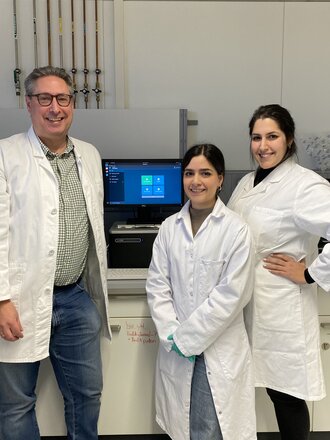
Sarah Chamas and Sabasadat Seyednikkhoo, doctoral candidates working on the NASH Project with Prof. Egert (from right) at the new nanopore sequencer
New research project started
Laundry is one of the most energy-intensive activities in the modern household. To save energy, laundry is increasingly washed at low temperatures, with liquid detergent and little water. “From a hygienic point of view, this is unfortunately a negative trend, as high temperatures, powder detergents containing bleach and a lot of water have been needed to reliably kill microorganisms,” says Prof. Dr. Markus Egert, head of the new ‘NASH’ research project at the HFU Schwenningen Campus.
NASH stands for “Sustainable Strategies for Laundry Hygiene”. The project is investigating whether new enzymes and living (probiotic) microorganisms can be used to improve the cleaning performance of detergents without using a lot of energy. “The idea of washing with microbes instead of against them is particularly fascinating,” enthuses Prof. Egert. Harmless bacteria added to a detergent could, for example, displace bad-smelling bacteria in the machine or on the laundry and thus help to prevent machine and laundry odours.
The NASH project is being funded with more than €730,000 by the Federal Ministry for Education and Research for three years (start August 2024), as part of the FH Kooperativ funding line. The company partners are Henkel AG & CO KGaA from Düsseldorf and Laborärzte Singen.
As an investment, a new DNA sequencer based on nanopore technology was acquired through the project, which can be used to identify the microbial communities in washing machines and on washed laundry down to species level. “This will definitely enable us to take our laundry hygiene research to a new level,” says Prof. Egert.
![[Translate to English:] Ansicht des Sequenzierers](https://www.hs-furtwangen.de/fileadmin/_processed_/b/5/csm_Nash1_b20bffdcdc.jpg)