Tips from the pros
Our Internal link opens in the same window:Center for Teaching and Learning (ZLL) regularly organises workshops on topics such as time management, learning methods, teaching methods and much more. The ZLL also supports lecturers in the development, implementation and further development of contemporary and innovative teaching models.
University teaching in transition
The semantic framework and the familiar frameworks within which university teaching operates are changing.
Before the pandemic, a lecture was generally associated with a face-to-face event in a lecture hall. During the pandemic, lectures were held exclusively online.
When discussing educational models, it is therefore essential to start with a uniform definition of the term. Furthermore, in the interests of sustainable teaching, it is necessary to break up familiar concepts of traditional face-to-face models and enrich them with new models.
The modality matrix (approx. 6 minutes) explained in the following interactive video serves as a guide to help structure the mixed forms of learning models that have become increasingly common in recent times.
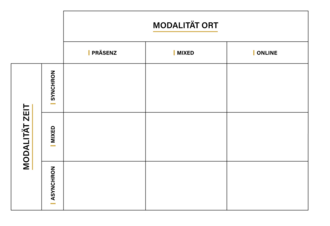
Courses are typically differentiated according to the “location” modality on a continuum from traditional face-to-face teaching to blended learning and purely online models.
The modality matrix supplements this view with the modality “time” and thus makes it possible to classify courses simultaneously on the vertical axis from maximum “synchronous” to maximum “asynchronous”.
What does “online teaching” mean and what do we mean when we say “presence”?
Terms relating to online teaching or digital teaching are often used indiscriminately and can evoke various associations. The concept of presence is also subject to change and is currently undergoing an expansion. A distinction is now often made between physical and virtual presence. The following glossary of terms should help to establish a common understanding of the most important terms within this online module.
Classroom teaching ...
... is to be understood as “analogue” teaching, in which teachers and students are physically present in the same room. There is direct personal contact between teachers and students and direct interaction between students is possible. Digital elements play a subordinate role and are often used for enrichment, e.g. in the form of an accompanying course structure in the learning management system or a classroom response system for live surveys in the lecture hall.
Virtual classroom teaching ...
... is conducted in a virtual space in which participants are given a sense of presence and interaction, although all participants may be physically in different locations. Virtual presence can be described as “presence without a physical correlate, face-to-face, but not body-to-body” (Reinmann, 2021, p.3).
Synchronous teaching ...
Asynchronous teaching ...
... refers to the temporal dimension and means that teachers and students do not interact at the same time. Students largely determine the time and speed of learning themselves. Typically, asynchronous learning is realised through the provision of learning materials and corresponding instructions. Opportunities for interaction with teachers or other students must be created in a targeted manner, e.g. through (peer) feedback, office hours, forum discussions and/or email support.
Hybrid teaching ...
Hyflex teaching ...
... describes a course that is offered not only synchronously and hybrid, i.e. in physical and digital rooms (via a video conferencing system), but also asynchronously. Students are free to choose the type of participation. They can either take part in the course synchronously and physically, join the course synchronously virtually or take part in the course by working asynchronously on the learning materials provided.
Blended-Learning …
... is a course that is organised in a combination of synchronous attendance phases and asynchronous online phases (self-study phases). These phases alternate, are closely interlinked and coordinated. Digital elements such as online learning materials, instructional videos, assignments, etc. play an important role in the self-study phases.
Further reading
- Hübner, S., & Walter, S. (2022). Hochschule Furtwangen: Digitale Beteiligungsformen in Präsenz- und Online-Lehre. In U. Dittler (Hrsg.), E-Learning: Digitale Lehr- und Lernangebote in Zeiten von Smart Devices und Online-Lehre (5. Aufl., S.81 – 100). Berlin: De Gruyter Oldenbourg.
- Reinmann, G. (2021). Präsenz-, Online- oder Hybrid-Lehre? Auf dem Weg zum post-pandemischen Teaching as Design. https://link.springer.com/chapter/10.1007/978-3-658-37204-0_1 (abgerufen am 12.04.2024)
Your contact persons
Are you also active in teaching and would like support and exchange?
Please get in touch with our Learning Services team: Email application is started:learning-services(at)hfu.eu