
The Black Forest Innovation Summit is a series of events organised by Furtwangen University designed to bring together businesses, academia, alumni, and other stakeholders from the region. With the theme, “University. Business. Impact.”, the summit focuses on current challenges, new markets, technological developments and concrete approaches to collaboration.
The goal is to translate this exchange into collective impact and actively promote cooperation between the university, the business community and the region.
Look forward to:
- Insights from academia and the professional world
- Networking with companies and other stakeholders from the region
- Insights into current developments and future trends
- New perspectives for collaboration, knowledge transfer and concrete next steps
12 November 2026: "Resilient Economy and Region"

We are hosting the Black Forest Innovation Summit 2026 in partnership with Volksbank Mittlerer Schwarzwald eG.
How can companies remain successful, innovative and future-proof even in challenging times?
What opportunities arise from new technologies, strong networks and regional collaboration?
With the theme “Resilient Economy and Region,” we’ll focus on how companies can navigate change, strengthen their competitiveness and tap into new opportunities for the future.
The range of topics extends from automation and new markets to cybersecurity and security technologies, as well as leadership and business succession in challenging times. In doing so, we bring together academic insights with concrete experiences and questions from the business world. Diverse perspectives are intended to provide new impetus, foster dialogue and highlight opportunities for partnership.
Registration
You can register for the Black Forest Innovation Summit 2026 via this link:
External link opens in a new window:I'll be there!
Agenda

- 1.00pm: Opening
- Reception
Dr. Alexandra Bormann, President of Furtwangen University
Martin Heinzmann, Chairman of the Board of Volksbank Mittlerer Schwarzwald eG - Opening presentation: “The Future of the Black Forest? A high-tech manufacturing hub!”
Philipp Hilsenbek, Deputy Managing Director (Schwarzwald-Baar-Heuberg Chamber of Industry and Commerce )
- Reception
- 2.00pm: Session 1
- Blockchain in practice – How new technology becomes a genuine business model – A 2.26
Sebastian Steiner (Volksbank Mittlerer Schwarzwald eG)
Prof. Dr. Marc Peter Radke (HFU) - Leadership in uncertain times – Insights from academia and practice at wiha Werkzeuge GmbH – A 2.16
Florian Eichin (Wiha Werkzeuge GmbH)
Prof. Dr. Armin Trost (HFU) - How can the region remain sustainable and future-proof? – Perspectives from the medical technology sector - A 2.24
Dr. Jens von Lackum, Chairman of the Board of Aesculap AG
Michael Martin, Managing Director of the KLS Martin Group
Julia Steckeler, Managing Director of MedicalMountains GmbH
PD Dr. Matthias Henschen, Medical Director of the Schwarzwald-Baar Medical Centre
Moderator: Prof. Dr. Martin Haimerl, Scientific Director of the HFU’s Tuttlingen Innovation and Research Centre - Achieving more with fewer staff? – How digital services strengthen businesses - A 2.18
Prof. Dr. Christian van Husen (HFU)
Nick Tugarin (HFU)
- Blockchain in practice – How new technology becomes a genuine business model – A 2.26
- 3.00pm: Sessions 2
- Hype or lever? Automation and robotics in the day-to-day operations of SMEs – A 2.26
Prof. Dr.-Ing. Michael Engler (HFU)
Alexander Zeifang and Sophie Zeifang Bayley (addmo UG and Schlösser Präzisionstechnik GmbH, Triberg) - Cybercrime in SMEs: Identifying risks, limiting damage, remaining capable of action – A 2.18
Enrico Bachmann (Baden-Württemberg State Criminal Police Office) - A new generation, new opportunities: business succession as a guarantee of regional innovation and future viability – A 2.16
Carolin Stoz (Streit Service & Solution GmbH & Co. KG)
Henriette Stanley (Black Forest-Baar-Heuberg Economic Development Agency mbH)
Ursula Schulz (Team Schulz GbR)
Christian Suhr (Level 4 PRO GmbH) - AuToS SW-BW: Shaping the technological transition together – prospects for the automotive region - A 2.20
Martin Schmidt, deputy head of the Innovation and Technology Division (Chamber of Industry and Commerce Schwarzwald-Baar-Heuberg)
Prof. Dr. Frank Allmendinger (HFU)
- Hype or lever? Automation and robotics in the day-to-day operations of SMEs – A 2.26
- 4.00pm: Sessions 3
- How do SMEs innovate? – Making SMEs fit for the future with new approaches – A 2.26
Steffen Erath (Hansgrohe) - Building resilience in organisations and teams – Insights into the RES-GAME research project and practical approaches for everyday working life - A 2.16
Prof. Dr. Kirsten Steinhausen (HFU)
Daniel Ecker (Accentus GmbH) - Sustainable and responsible digitalisation – Identifying impacts and shaping them consciously – A 2.18
Professor Dr. Stefanie Betz (HFU) - AuToS SW-BW: Shaping Technological Change Together – Identifying Opportunities, Developing Solutions - A 2.20
Dimitri Schultheis, member of academic staff at AuToS SW-BW (HFU)
Sara Hemati, member of academic staff at AuToS SW-BW (HFU and doctoral candidate at Virginia Tech)
Dr. Armin Müller, Head of the HFU Academy (HFU)
Annett Auer-Thoß, Head of Division (IHK Academy)
Rudolf Merz, Transfer Manager (HFU)
Fabian Keppeler, Research Assistant and Project Manager, Institute for the Automotive Industry (IfA), Nürtingen-Geislingen University of Applied Sciences for Business and the Environment
Tobias Huthmacher, research assistant, Institute for the Automotive Industry (IfA), Nürtingen-Geislingen University of Applied Sciences for Business and the Environment
Simon Herrlich, Business Development (Hahn-Schickard)
Philipp Raimann (Hahn-Schickard)
Muhammad Ahsan (Hahn-Schickard)
- How do SMEs innovate? – Making SMEs fit for the future with new approaches – A 2.26
- 5.00pm: Keynote
- “Courage for the Future: AI, Resilience and Co-opetition as a Formula for Success for the Region and SMEs”
Prof. Dr. Isabell Welpe (Professor of Strategy and Organisation at the Technical University of Munich)
- “Courage for the Future: AI, Resilience and Co-opetition as a Formula for Success for the Region and SMEs”
- 6.00pm: Social gathering
Do stay a little longer! Look forward to good conversations, new encounters and a delightful way to round off the evening.
Opening presentation: Philipp Hilsenbek
Deputy Managing Director of the Schwarzwald-Baar-Heuberg Chamber of Industry and Commerce and expert in regional development and economic policy
How can the Black Forest remain a competitive industrial hub in the future? What skills, networks, and framework conditions are crucial for successfully navigating this transformation?
Philipp Hilsenbek, Deputy Managing Director of the Black Forest-Baar-Heuberg Chamber of Commerce and Industry (IHK), will open the technical session of the Black Forest Innovation Summit 2026 with these questions.
His keynote address, “The future of the Black Forest? A high-tech manufacturing hub!” highlights current developments and challenges for companies in the region and showcases the opportunities created by innovation, collaboration and knowledge transfer between academia and industry.
The keynote sets the stage for the summit’s other topics and invites participants to collectively envision the future of the Black Forest as a business hub.


Keynote: Prof. Dr. Isabell Welpe
Expert in leadership, innovation, and corporate sustainability from the Technical University of Munich

Prof. Dr. Isabell M. Welpe is a professor and head of the Strategy and Organisation Research Group at the Technical University of Munich. Her current projects focus on the digital transformation of companies, the impact of digital technologies on the economy and organisations, and the future of leadership and work/organisation design. She has published studies on topics including “Disrupting Industries with Blockchain,” “Digital Business Models,” and “Social Media as Information Markets.” She has spoken multiple times at the Digital Life Design (DLD) conference and was named by Capital magazine as one of the Top 40 Under 40 in the “digital elite” and among the “leading 40 thinkers in HR.” Her current research focuses on the potential of emerging technologies, such as AI and Web3, for novel value chains, business models and organisational forms.
Isabell M. Welpe studied management at Ludwig Maximilian University in Munich and as a visiting student at the Massachusetts Institute of Technology in Boston, USA. She did her master’s degree at the London School of Economics. She has been a visiting professor at the Keck Graduate Institute in Claremont, USA, a postdoctoral fellow at the Carlson School of Management at the University of Minnesota, and a postdoctoral fellow at the Max Planck Institute for Economics. She is a Research Fellow at the Centre for Blockchain Technologies at University College London. Her research has been featured in the media, including in the Harvard Business Manager, MIT Sloan Management Review, Süddeutsche Zeitung, Handelsblatt, ManagerMagazin, Die Welt, BR and WirtschaftsWoche. Her work has received numerous national and international awards, including the Best Paper Award from the Academy of Management (AOM), the Hawaii International Conference on System Sciences (HICSS) and the Association of University Professors of Business Administration (VHB). Professor Welpe is a board member of the Centre for Digital Technology & Management (CDTM) and a member of the “Münchner Kreis”. She also serves on several advisory boards.
Focus: Transformation & New Markets
Markets are changing, business models are coming under pressure and established industries are facing new challenges. Resilient companies can further develop their existing capabilities, respond to change and tap into new markets. Transformation thus becomes an opportunity to secure value creation and competitiveness in the long term.
- 2.00pm: How can the region remain sustainable and future-proof – perspectives from the medical technology sector?
The Schwarzwald-Baar-Heuberg region is one of the world’s major centres for medical technology. But how is the industry responding to technological change, international competition and changing economic conditions? And what lessons can be applied to other sectors? Four guests will bring different perspectives:- Dr, Jens von Lackum, Chairman of the Executive Board of Aesculap AG, will represent the perspective of an internationally active medical technology company.
- Michael Martin, Managing Director of the KLS Martin Group, will share the perspective of another international company in the sector.
- Julia Steckeler, Managing Director of MedicalMountains GmbH, will highlight the importance of regional networks, collaborative innovation projects and regulatory frameworks.
- PD Dr. med. Matthias Henschen, Medical Director of Schwarzwald-Baar Klinikum, will outline the requirements of healthcare provision and the challenges of introducing new technologies into clinical practice.
Moderator: Prof. Dr. Martin Haimerl, Scientific Director of the Innovation and Research Centre Tuttlingen at HFU
The discussion will focus on what businesses, healthcare, academia and policymakers can achieve together. It will also explore practical experience and potential solutions from which other sectors can benefit, as well as how the region can safeguard its economic strength and quality of life over the long term.
3.00pm and 4.00pm: AuToS SW-BW – Shaping
technological change together New technologies, changing markets and growing demands: how can the region’s automotive supply industry remain competitive? The Internal link opens in the same window:AuToS SW-BW transformation network brings together academia and business to develop perspectives on technological change. Two short presentations will shed light on the future of the automotive region and demonstrate how companies can capitalise on existing strengths and explore new technological development pathways. Participants will then be invited to get involved: at five themed round-table discussions, specific challenges, experiences and potential solutions will be discussed. An overview of
the five topics:- Artificial Intelligence: How can artificial intelligence be usefully applied in industrial processes and day-to-day company operations?
- Professional development: What skills do companies and employees need to navigate this transformation?
- Partnership: How can existing skills be turned into joint innovation projects?
- New markets: How can companies identify and tap into new business areas?
- Technology transfer: How does applied research become a commercially viable product?
Share your perspectives, exchange ideas with experts and discover new opportunities for collaboration!
- Martin Schmidt, Deputy Head of the Innovation and Technology Division (IHK Schwarzwald-Baar-Heuberg)
- Prof. Dr. Frank Allmendinger (at HFU)
- Dimitri Schultheis, member of academic staff at AuToS SW-BW (HFU)
- Sara Hemati, member of academic staff at AuToS SW-BW (HFU; doctoral candidate at Virginia Tech)
- Dr. Armin Müller, Head of the HFU Academy
- Annett Auer-Thoß, Head of Division (IHK Academy)
- Rudolf Merz, Transfer Manager (at HFU)
- Fabian Keppeler, Research Assistant and Project Manager (Institute for the Automotive Industry (IfA), Nürtingen-Geislingen University of Applied Sciences for Business and the Environment)
- Tobias Huthmacher, Research Assistant (Institute for the Automotive Industry (IfA), Nürtingen-Geislingen University of Applied Sciences for Business and the Environment)
- Simon Herrlich, Business Development (Hahn-Schickard)
- Philipp Raimann (Hahn-Schickard)
- Muhammad Ahsan (Hahn-Schickard)


Focus: IT Security & Responsible Digitalisation
Resilience also means identifying risks at an early stage and dealing responsibly with the implications of technological developments. This includes protection against cyber-attacks and the security of networked systems, as well as the question of what long-term effects digital technologies have on businesses, people and the environment.
- 2.00pm: Achieving more with fewer staff? – How digital services strengthen
businesses How can businesses maintain their performance and tap into new business opportunities despite a shortage of skilled workers? Digital services offer the opportunity to make processes more efficient, ease the workload on members of staff and develop new business models. Prof. Dr. Christian van Husen and Nick Tugarin from Furtwangen University will use practical examples to demonstrate how businesses can develop and successfully implement digital services. The discussion will also cover the potential of AI and the opportunities for collaboration between academia and business.- Prof. Dr. Christian van Husen is Professor of Service Management and Head of the Institute for Product and Service Engineering at Furtwangen University. His research focus is on service innovation, smart services and product-service systems.
- Nick Tugarin is a research assistant at the same institute and works on the ‘Centre for Industry-Related Services’ project. As part of his doctorate research, he is investigating the development and deployment of teams comprising humans and AI agents in service-oriented organisations.
- 3.00pm: Cybercrime in SMEs: identifying risks, limiting damage, remaining
operational Cyberattacks have long since ceased to target only large corporations. Small and medium-sized enterprises (SMEs) in particular are attractive targets – with potentially significant consequences for the day-to-day operation of the company.
Enrico Bachmann, Senior Detective Inspector at the Baden-Württemberg State Criminal Police Office, provides an insight into the current cybercrime threat landscape for SMEs. He explains who is behind the attacks, what the perpetrators’ objectives are and how, for example, phishing attacks can escalate.
The focus is on practical measures: how can businesses protect themselves effectively? Bachmann presents specific prevention measures and the cyber security check for SMEs.
As a member of staff at the Central Cybercrime Contact Point (ZAC), he is familiar with both the threat landscape and the challenges faced by affected businesses.- Senior Detective Inspector Enrico Bachmann, State Criminal Investigation Office
- 4.00pm: Sustainable and responsible digitalisation – recognising impacts and shaping
them consciously Digital solutions have not only technical and business implications, but also environmental and social impacts. The Sustainable Awareness Framework helps companies to recognise these impacts at an early stage and to systematically factor sustainability into digital decision-making. Prof. Dr Stefanie Betz from Furtwangen University will demonstrate why sustainable digitalisation extends far beyond the energy consumption of IT systems and highlight the often-overlooked impacts that digital technologies can have. In an interactive workshop, participants will apply the scientifically developed method themselves using concrete practical examples. They will learn how to identify the potential impacts of digital decisions at an early stage and take them into account when developing new solutions. The workshop is aimed at anyone who wishes to shape digitalisation in a responsible and future-proof manner. No prior technical knowledge is required.Prof. Dr. Stefanie Betz, Furtwangen University


Focus: Innovation & Adaptability
Resilient companies must not only recognise change, but also be able to actively shape it. Innovative strength and the ability to embrace new developments, test solutions and further develop existing structures create scope for action in a changing environment.
- 2.00 pm:Blockchain in practice – How new technology becomes a genuine business model
Blockchain is more than just Bitcoin. But what opportunities does the technology offer businesses, and how can concrete applications and new business models be developed from it?
Prof. Dr. Marc Peter Radke from Furtwangen University demonstrates the possibilities opened up by blockchain, tokenisation and programmable transactions – from supply chains and digital supporting documents to new forms of financing. Sebastian Steiner from Volksbank Mittlerer Schwarzwald eG provides insights into practical implementation. Using the regional bank as an example, he demonstrates how a start with Bitcoin can lead to the development of new capabilities and further reference fields. Together, they explore how businesses can conduct early assessments of new technologies, implement them with partners and develop business opportunities from them.- Sebastian Steiner, Volksbank Mittlerer Schwarzwald (Head of Retail Banking)
- Prof. Dr. Marc Peter Radke, Furtwangen University
- 3.00pm: Hype or catalyst? Automation and robotics in the day-to-day operations of SMEs
The pressure to automate, a shortage of skilled workers and rising costs are major concerns for many SMEs – yet at the same time, automation solutions are often too complex, too inflexible or too expensive.
Using the example of Schlösser Präzisionsteile and the resulting spin-off, addmo, Alexander Zeifang and Sophie Zeifang Bayley demonstrate how automation can also be successfully implemented in a pragmatic, step-by-step manner.
Prof. Dr. Michael Engler from Furtwangen University adds the academic perspective, clarifying what robotics can actually achieve today and where it is still more hype than business reality. Together, they will address the question of how humans and machines can work together effectively in SMEs, and which solutions are also viable for small and medium-sized enterprises.- Alexander Zeifang, co-founder of addmo UG and head of management at Schlösser Präzisionstechnik GmbH
- Sophie Zeifang Bayley, addmo UG (Strategy and Transformation)
- Prof. Dr. Michael Engler, Furtwangen University (Professor of Intelligent Products and Production Systems)
- 4.00pm: How do SMEs innovate? – Making SMEs fit for the future with new approaches
How can innovation succeed beyond day-to-day business – and how can even established companies develop new ideas and business areas?
Using the example of a long-established Black Forest company, Steffen Erath demonstrates how innovation can also work from the bottom up and what role a functioning innovation ecosystem plays in this. The focus is on how companies can further develop their core business, tap into new areas of innovation and thereby create additional options for the future.
Drawing on his many years’ experience in innovation work at Hansgrohe, Erath now heads the company’s InnoLab. He also focuses on corporate start-up innovations and collaboration with start-ups.Steffen Erath, Hansgrohe SE (Head of Innovation)


Focus: Leadership & Corporate Culture
Resilience does not arise solely from technology or new markets. A company’s people and structures are also crucial. Good leadership, a sustainable corporate culture and a forward-looking approach to change and succession help companies to remain capable of acting, even in uncertain times.
- 2.00pm: Leadership in uncertain times – insights from academia and practice at wiha Werkzeuge GmbH
How can leadership succeed when companies are simultaneously facing business pressure, a shortage of skilled workers, technological change and uncertainty? This is precisely where the joint session led by Florian Eichin, Chief Digital Officer at Wiha Werkzeuge GmbH, and Prof. Dr. Armin Trost, dean of the faculty of Business, Design & Media at Furtwangen University, comes in. From both academic and practical perspectives, they will demonstrate how leadership can empower members of staff to take greater personal responsibility, thereby strengthening companies’ ability to adapt. Florian Eichin contributes specific insights from organisational development at Wiha; together, they discuss what works in practice, where the obstacles lie and what other companies can learn from this.- Florian Eichin, wiha Werkzeuge GmbH (Head of the Technology Centre)
- Prof. Dr. Armin Trost, Furtwangen University
- 3.00pm: A new generation, new opportunities: business succession as a guarantee of regional innovation and future viability
Business succession means more than simply handing over a company. It offers the chance to preserve tried-and-tested practices, introduce new ideas and develop companies in a way that ensures their future viability. But how does one successfully take on entrepreneurial responsibility? What challenges does succession entail, and how can the generational transition be harnessed to drive innovation and growth? Carolin Stoz (Streit Service & Solution GmbH & Co. KG) and Christian Suhr (Level 4 PRO) report on their experiences of both intra-family and external business succession. They provide insights into their personal journeys, key decisions and the challenges of balancing tradition and change. Ursula Schulz (Team Schulz) adds the perspective of succession consultancy and demonstrates why successful business succession also requires strong regional networks. Moderated by Henriette Stanley (Wirtschaftsförderungsgesellschaft Schwarzwald-Baar-Heuberg mbH), the session explores how business succession can become a catalyst for innovation, economic resilience and the future of our region.- Carolin Stoz, Streit Service & Solution GmbH & Co. KG, (Managing Director)
- Christian Suhr, Level 4 PRO GmbH
- Henriette Stanley, Wirtschaftsförderungsgesellschaft Schwarzwald-Baar-Heuberg mbH (Managing Director)
- Ursula Schulz, Team Schulz Gbr
- 4.00pm: Building resilience in organisations and teams – insights into the RES-GAME research project and practical approaches for everyday working life
How can teams and organisations remain capable of acting even in the face of major changes, high pressure and unexpected challenges? And how can resilience be specifically strengthened in everyday working life? Prof. Dr Kirsten Steinhausen (Furtwangen University) and Daniel Ecker (Accentus GmbH) will provide insights into the RES-GAME research project and use concrete examples to demonstrate how resilience can support companies’ capacity for change and innovation. The session then moves on to a practical component: at various stations, participants will learn about simple, immediately applicable tools they can use to strengthen resilience in their day-to-day work and leadership roles. The group discussion provides an opportunity to share experiences and gain fresh insights.- Daniel Ecker, Accentus GmbH
- Prof. Dr. Kirsten Steinhausen (Furtwangen University)


How to get to the Black Forest Innovation Summit
The event will take place on the Furtwangen campus of our university.
Internal link opens in the same window:Directions on how to get there
Your contact person
I’m happy to answer any questions you may have about the Black Forest Innovation Summit






2024: The future in view
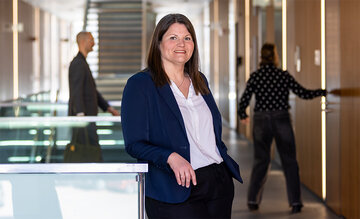
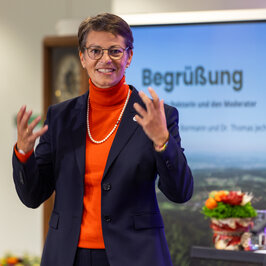
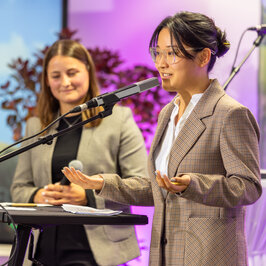
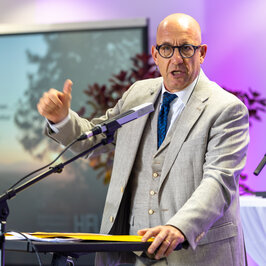
In 2024, Furtwangen University launched a new platform for future-oriented topics and solutions with the “Black Forest Innovation Summit.” At the kick-off event on the Furtwangen campus, the Baden-Württemberg Minister of Science, Research, and the Arts, Petra Olschowski, was the guest of honour, and high-ranking representatives from academia, business, and politics, as well as members of the university executive of other colleges and universities, accepted our invitation. At an extensive innovation exhibition, guests learned about projects and research collaborations through which HFU is finding solutions to the challenges of tomorrow.
Internal link opens in the same window:Read more about the Black Forest Innovation Summit